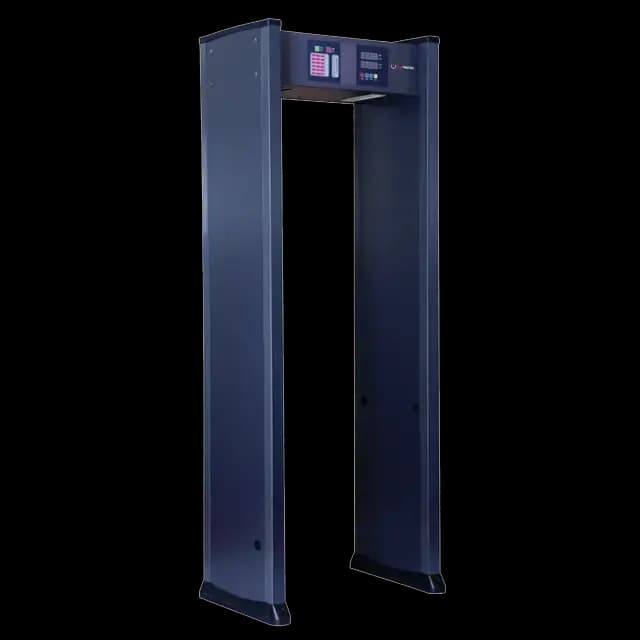
A door frame metal detector, commonly abbreviated as DFMD, is a walk-through security screening arch positioned at a building or event entrance to detect concealed metallic objects as a person passes through it at normal walking pace. It is one of the most widely deployed physical security tools in the world precisely because it requires no active cooperation beyond walking through a doorway, making it practical for high-footfall entrances where manual searching of every visitor would be impossible.
TimeWatch Arabia supplies and installs door frame metal detectors across Saudi Arabia, serving government buildings, courts, event venues, shopping malls, hotels, schools, and industrial facilities that need to screen visitors, staff or contractors for concealed metallic items as a matter of routine security policy or regulatory requirement.
This page sets out what a DFMD is, how the technology works, the features that distinguish a well-specified installation from a poorly-configured one, why organisations across the Kingdom choose TimeWatch Arabia, and the questions we are asked most frequently by procurement and security teams.
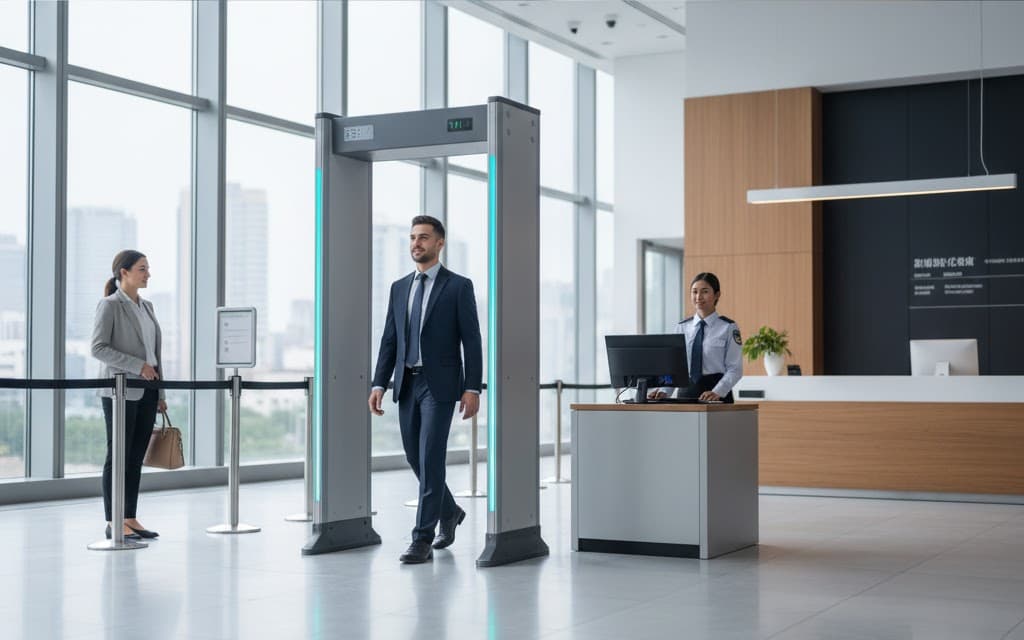
Physically, a DFMD is a rectangular archway, typically constructed from a lightweight but sturdy frame, through which a person walks in a single continuous motion. Embedded within the frame's panels are multiple coil sensors that generate a low-level electromagnetic field. When a metallic object of sufficient size passes through that field, it disturbs it in a measurable way, and the system registers a detection event.
What separates a modern, multi-zone DFMD from a basic single-zone unit is the ability to localise where on the body the metal was detected — for example, distinguishing between an object near the ankle versus one near the chest. This is achieved by dividing the archway into a number of vertical detection zones, commonly ranging from 6 zones in a basic configuration up to 33 zones in a high-specification unit, each independently monitored and each triggering its own indicator light when an object is detected in that zone.
This zone-level detail matters enormously in practice. A single-zone detector that simply beeps tells a security officer that something metallic was found somewhere on the person, requiring a full manual pat-down to locate it. A multi-zone detector narrows that search to a specific band of the body, dramatically speeding up secondary screening and reducing the intrusiveness of the check for the person being screened — an important consideration at high-traffic entrances such as malls, hotels and government buildings across Saudi Arabia.
The screening process is designed to be fast and non-intrusive so that it can be deployed at entrances with continuous foot traffic without creating long queues.
A person approaches and walks through the archway at a normal, steady pace — sudden stops or excessively slow movement can affect detection accuracy, which is why staff are trained to guide visitors through smoothly. As the person passes through, the embedded sensors continuously monitor the electromagnetic field across every detection zone simultaneously.
If a metallic object above the configured sensitivity threshold is detected in any zone, the unit triggers a visual indicator — typically an LED display showing exactly which zone or zones registered a detection — along with an audible alarm. Security personnel positioned at the exit side of the archway can then direct the visitor to a secondary check, focused specifically on the indicated zone, using a handheld detector or a manual check.
Sensitivity is fully adjustable per site and per threat profile. A government building screening for weapons will typically run at a higher sensitivity than a retail environment primarily concerned with theft prevention, and TimeWatch Arabia configures each installation's sensitivity based on the site's actual security requirement rather than shipping every unit with the same default setting.
Throughput counting is a standard feature on modern units, logging the number of people who pass through the archway and the number of alarm events, giving security management data they can use for staffing, auditing and incident review.

Detection zones are the single most important specification when comparing DFMD units. TimeWatch Arabia supplies configurations across the common range — 6, 12, 18 and 33-zone units — allowing a site to choose the level of body-location precision appropriate to its throughput and security requirement. A busy mall entrance may prioritise a mid-range zone count balanced against speed, while a government facility with a lower but more sensitive screening requirement may specify a higher zone count for maximum precision.

Adjustable sensitivity per zone allows security teams to fine-tune detection thresholds independently across the height of the archway, which is useful for filtering out items that are not security-relevant — belt buckles or shoe fittings, for example — while maintaining high sensitivity in zones more likely to conceal a genuine threat.

Weather-resistant construction is available for units deployed at outdoor gates, event perimeters, or semi-covered entrances, which is a common requirement across Saudi Arabia given outdoor event and gate screening at large public gatherings, and given the heat and dust conditions typical across much of the Kingdom for much of the year.

High pass-through throughput is engineered into the archway design so that screening does not become the bottleneck at busy entrances such as mall openings, stadium gates or government office arrivals during peak hours.

LED zone indicators and footfall/alarm counters give on-site security staff and central management clear, auditable data on how the unit is performing over time.
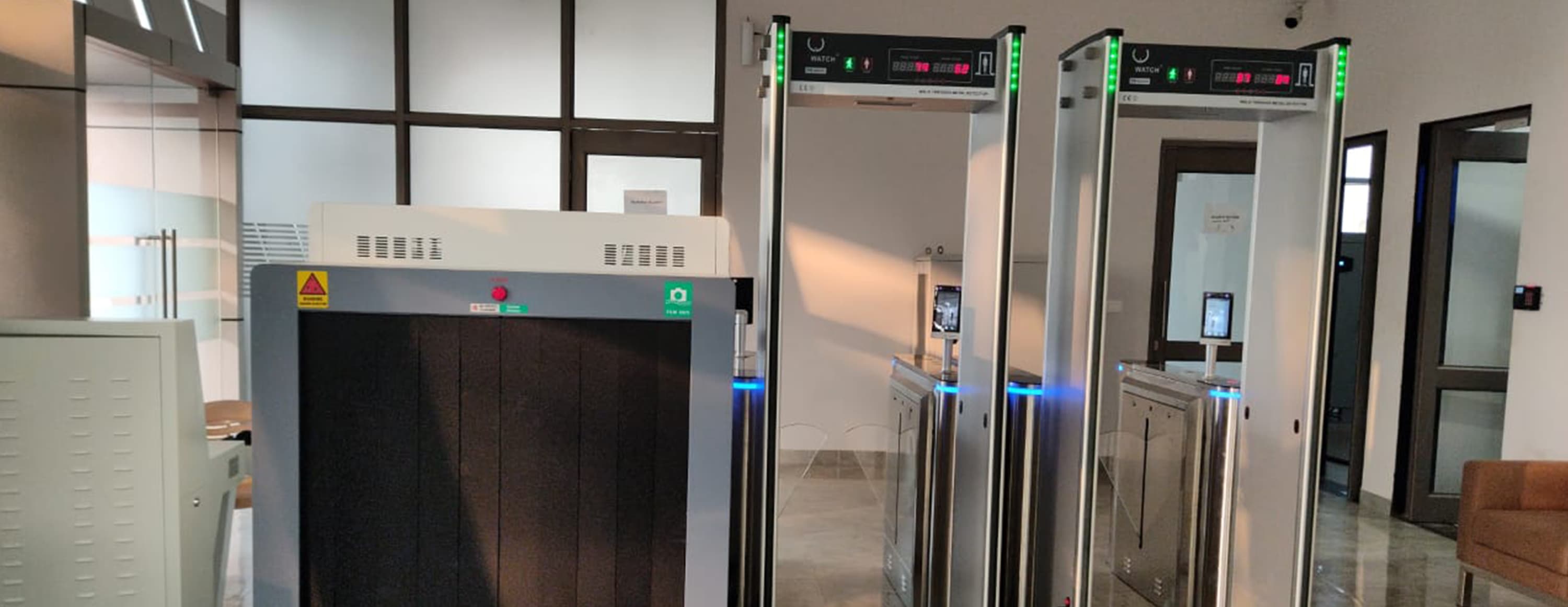
TimeWatch Arabia supplies and installs DFMD units as part of a broader security-entrance product range that includes X-ray baggage scanners, boom barriers and turnstiles, meaning a single vendor can deliver a complete entrance-security solution for a site rather than requiring separate suppliers for each component. This matters for coordination during installation and for accountability during support.
Every installation includes on-site configuration of sensitivity and zone thresholds tailored to the specific site and its actual security requirement, rather than a generic factory default. TimeWatch Arabia's local presence across Saudi Arabia means installation, staff training on operating procedure, and after-sales maintenance are all handled by a team that understands the operating environment — from outdoor event screening in the heat of a Riyadh summer to high-throughput mall entrances in Jeddah.
Because we are a manufacturer and provider rather than a pass-through reseller, replacement parts, firmware updates and technical support are available directly, without the delays that can come from routing every service request through an overseas supplier with no regional footprint.
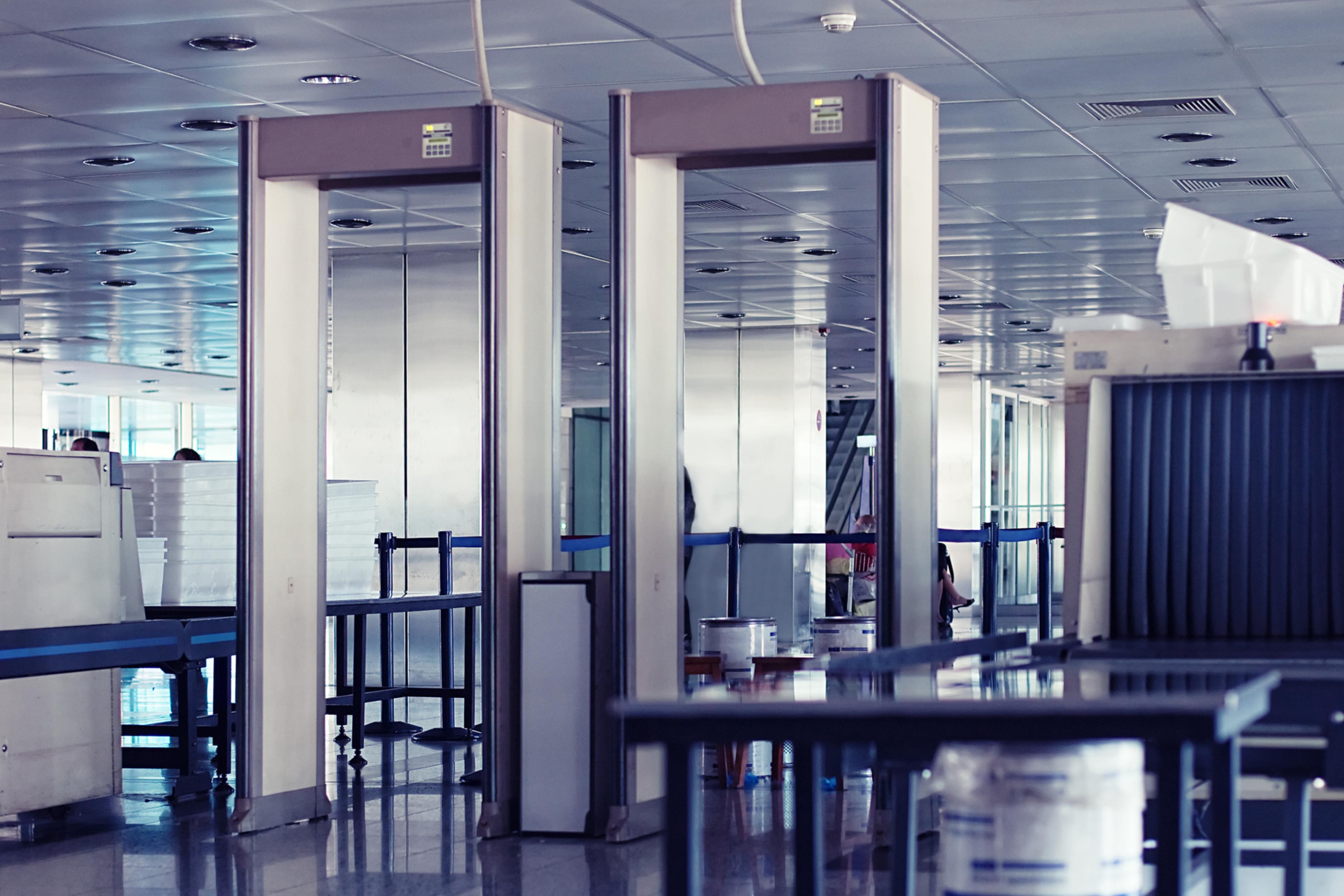
Government buildings and courts across Saudi Arabia use multi-zone DFMD screening as a routine part of visitor and staff access control, often alongside X-ray baggage scanning for a complete entrance-security checkpoint.
Airports and transit hubs deploy DFMD units at multiple checkpoints to screen high volumes of passengers efficiently.
Shopping malls and retail complexes in cities such as Riyadh, Jeddah and Dammam use DFMD screening at main entrances, particularly during high-footfall periods and major sales events, to maintain visitor safety without slowing entry significantly.
Hotels use discreet, well-configured units at guest and service entrances as part of a broader hospitality security posture, particularly for properties hosting large events or VIP guests.
Stadiums and event venues rely on high-throughput DFMD screening at multiple gates to process large crowds arriving within a short window before an event starts.
Schools and universities across the Kingdom increasingly deploy DFMD screening at main entrances as part of campus safety policy.
Industrial and factory sites use DFMD screening at entry points both for security and, in some cases, as part of asset-protection procedures to prevent unauthorised removal of metallic tools or components.
TimeWatch Arabia begins every DFMD installation with a site assessment covering entrance layout, expected foot traffic, power availability, and the specific security policy the client needs the system to support. Based on this assessment, we recommend the appropriate zone configuration and sensitivity profile for the site.
Installation includes physical positioning and levelling of the archway, power connection, and full calibration of sensitivity thresholds across all zones. Security staff are trained on correct screening procedure — including how to guide visitors through at the right pace and how to interpret zone-level alarm indicators — since operator training has a direct and significant impact on real-world detection accuracy.
After installation, TimeWatch Arabia provides ongoing support covering recalibration, firmware updates and hardware servicing, ensuring the unit continues to perform reliably across years of continuous use in Saudi Arabia's climate.
Specifying a door frame metal detector correctly starts with understanding the site's actual risk profile and traffic pattern, rather than defaulting to whichever unit happens to be on a supplier's shelf. A government building or court with a genuine weapons-screening requirement needs a higher zone count and a higher sensitivity threshold than a retail environment primarily concerned with routine visitor safety, and specifying the wrong configuration in either direction creates real problems: too little sensitivity misses genuine threats, while excessive sensitivity for the environment generates constant nuisance alarms from belt buckles, phones and everyday metal items, which quickly erodes staff and visitor confidence in the system.
Traffic volume is the second major factor. A single archway at a low-footfall office entrance can comfortably screen everyone who arrives without creating a queue, whereas a stadium gate or a mall entrance during a major sales event may need multiple units operating in parallel to keep pass-through fast enough to avoid a bottleneck at the door. TimeWatch Arabia's site assessment considers peak-hour arrival patterns specifically, not just average daily footfall, since it is the peak that determines whether one unit is sufficient or whether additional archways are needed.
Indoor versus outdoor placement also shapes the right specification. An indoor lobby unit can use a standard build, while a unit positioned at an outdoor event gate or a semi-covered entrance needs weather-resistant construction to perform consistently through Saudi Arabia's heat and dust without drift in calibration over time. TimeWatch Arabia's team walks through each of these factors during the site visit and recommends a configuration matched to the actual environment, rather than a generic default applied regardless of where the unit will be installed.
TimeWatch Arabia supplies and installs door frame metal detectors across all regions of Saudi Arabia, including Riyadh, Jeddah, Mecca, Medina, Dammam, Al Khobar, Dhahran, Jubail, Yanbu, Taif, Tabuk, Abha and Buraidah, with installation, staff training and after-sales support provided locally wherever your site is located.
It depends on the site's throughput and precision requirements. Common configurations range from 6 to 33 zones, with higher zone counts giving more precise localisation of a detected object on the body. TimeWatch Arabia recommends the right configuration after assessing your specific entrance and security requirement.
This depends on peak-hour arrival volume rather than average daily footfall. TimeWatch Arabia assesses your busiest expected periods — such as an event start time or a store opening — to determine whether one archway is sufficient or whether parallel units are needed to avoid a queue.
Yes. Weather-resistant models are available specifically for outdoor gates, event perimeters and semi-covered entrances, built to withstand heat, dust and general outdoor exposure typical across Saudi Arabia.
Yes. Sensitivity is fully adjustable per zone and is configured on-site by TimeWatch Arabia's team to match the specific security requirement of the venue, whether that is a government facility, a retail environment or an industrial site.
Properly configured units are engineered for high pass-through throughput, allowing continuous foot traffic without significant delay, provided visitors are guided through at a steady, normal pace as trained staff are shown to do.
Yes. Footfall and alarm-event counting is a standard feature, giving security management auditable data for staffing decisions and incident review.
Configuration — including zone count, sensitivity profile and indoor or outdoor build — varies by site, so we recommend contacting TimeWatch Arabia directly for a tailored assessment and quote based on your specific entrance and security requirement.
Yes. TimeWatch Arabia provides supply, installation, staff training and after-sales support for DFMD units in all major regions of the Kingdom.
Yes. Many sites deploy a DFMD for personal screening alongside an X-ray baggage scanner for bag and parcel screening, forming a complete entrance-security checkpoint, and TimeWatch Arabia can supply and install both as a single coordinated solution.
Call: +966 53 915 7364
Email: sales@timewatcharabia.com