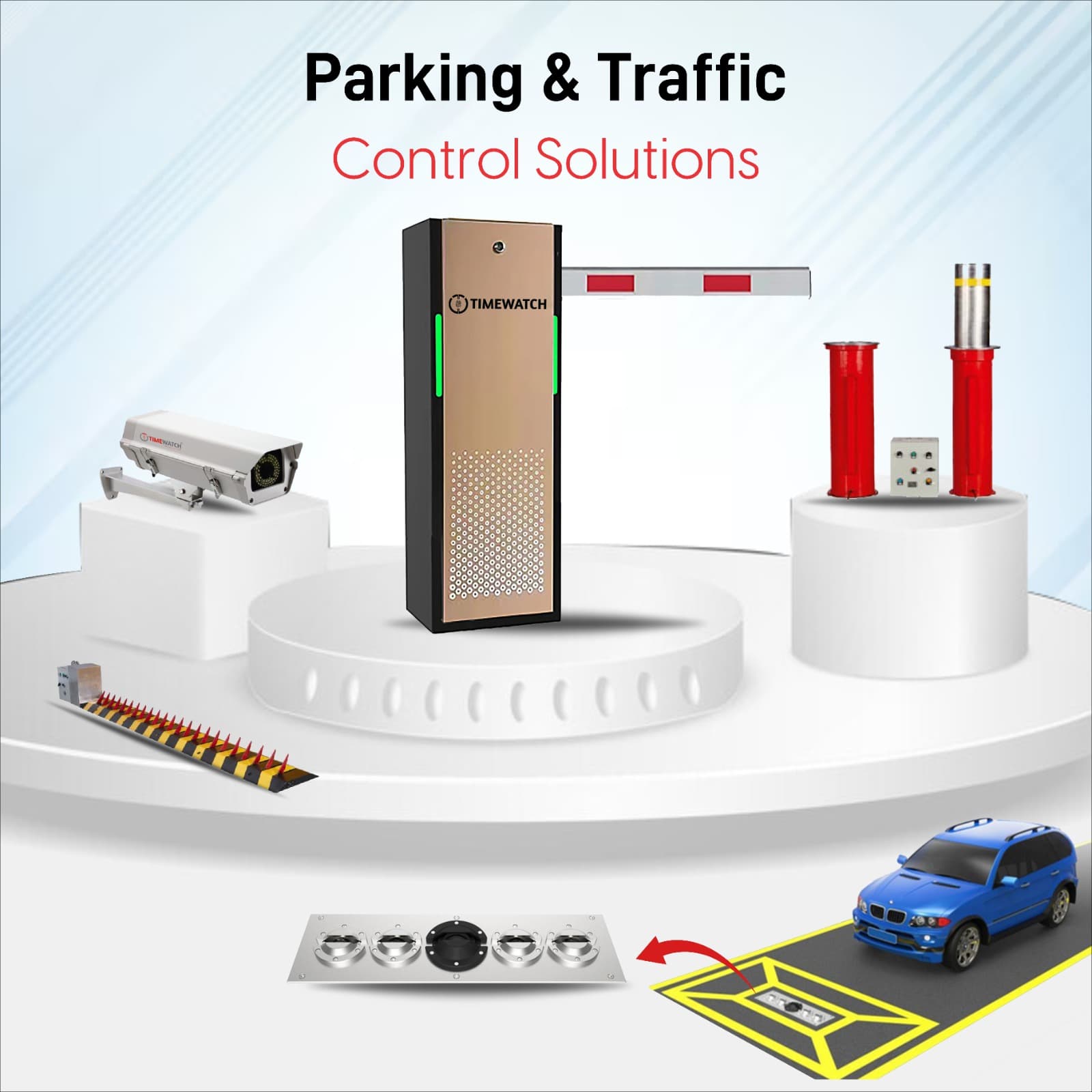
A parking management solution brings together automatic boom barriers, vehicle identification technology — UHF RFID tags or ANPR number-plate cameras — and central software into a single, coordinated system that automates entry, exit, ticketing and reporting at a parking facility. Rather than treating each of these as a separate purchase, a well-designed solution ensures the hardware and software work together from day one, giving facilities management real-time visibility and control over every vehicle movement on-site.
TimeWatch Arabia designs, supplies and installs complete parking management solutions across Saudi Arabia, serving shopping malls, corporate offices, hospitals and residential compounds that need to manage vehicle access efficiently at scale, whether that means a handful of reserved spaces or a multi-level facility handling thousands of vehicles daily.
This page explains what a parking management solution includes, how the different components work together, the benefits organisations see after deployment, why TimeWatch Arabia is chosen across the Kingdom, and the questions most frequently asked during evaluation.
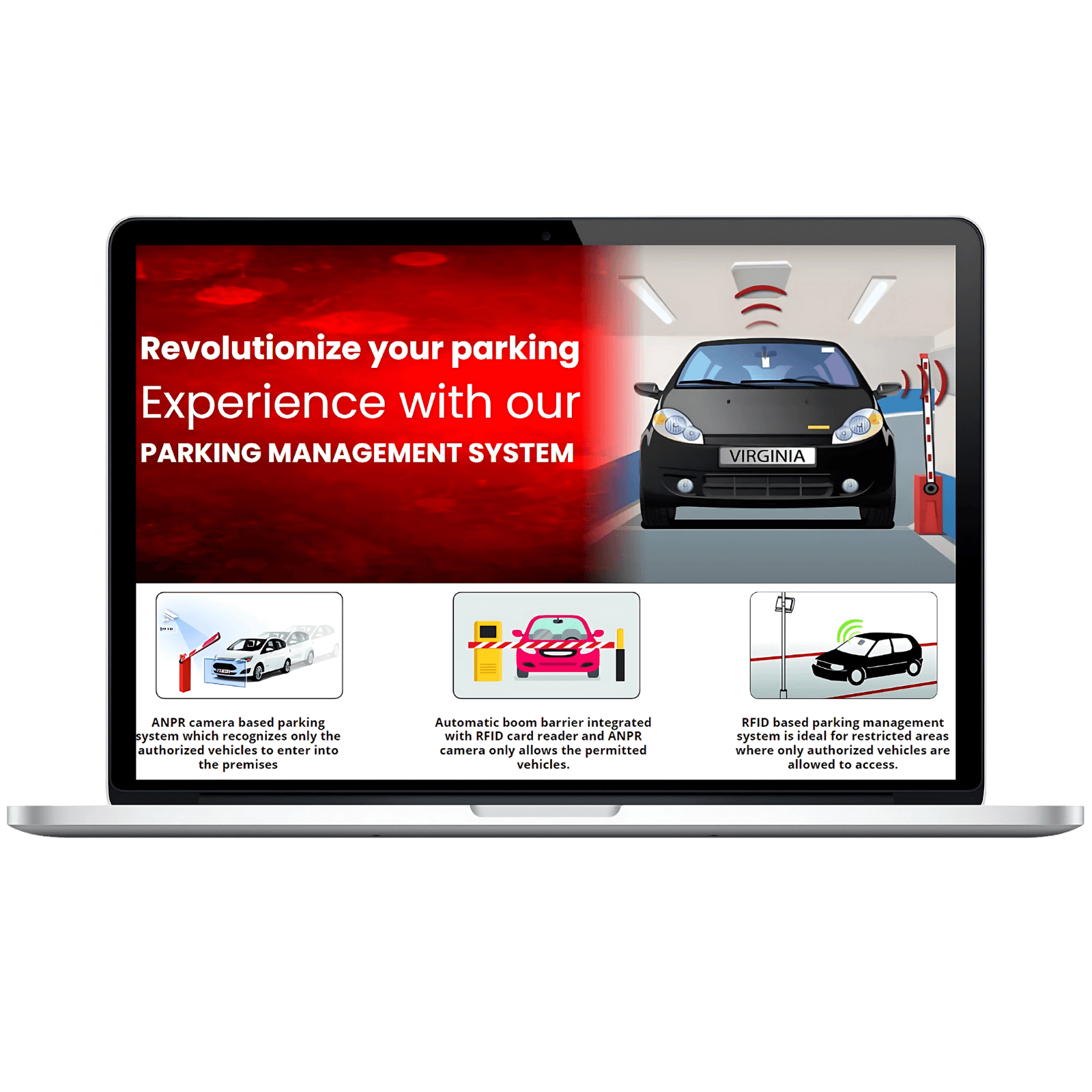
A parking management solution is not a single product but an integrated system built from several components working in concert. At the entry and exit lanes, automatic boom barriers physically control vehicle access. Vehicle identification — typically UHF RFID tags for registered vehicles, ANPR cameras that read number plates automatically, or a combination of both — determines whether a given vehicle should be allowed through without requiring a security guard to manually approve every entry.
For visitors and vehicles not registered in the system, a ticketing or QR-based access method provides an alternative entry path, often paired with a pay-station or validation process depending on the site's commercial model. Behind all of this sits central management software, which consolidates data from every lane and gate into a single dashboard, tracks real-time occupancy, manages monthly-pass holders, and generates the operational reports facilities management actually uses to run the site.
The value of treating this as a single solution rather than a set of disconnected purchases is coordination: the boom barrier, the identification hardware and the software are specified and configured together from the outset, so the system works reliably from day one rather than requiring painful post-installation integration between components purchased from different vendors.

As a registered vehicle approaches an entry lane, its UHF tag or number plate is identified automatically, and the software checks it against the authorised database in real time. On a positive match, the boom barrier is signalled to open, timed so the vehicle can pass through without stopping, and the event is logged against the vehicle's record.

For a visitor without a registered tag, the entry lane can dispense a ticket or generate a QR code, recording the entry time so that duration-based charging or validation can be applied at exit, if the site's commercial model requires it. At exit, the same identification process runs in reverse — verifying the vehicle or ticket and opening the exit barrier — while the software closes out that vehicle's occupancy record.

Throughout the day, the central software maintains a live count of occupied and available spaces across the facility, which can be displayed on entrance signage to direct incoming drivers efficiently, particularly valuable at large multi-level facilities such as mall parking structures. All of this data — entries, exits, occupancy trends, and monthly-pass usage — feeds into reporting tools that facilities and finance teams use to understand utilisation and plan capacity.
Faster entry and exit is the most immediately visible benefit, since hands-free UHF or ANPR identification removes the need for vehicles to stop and interact with a reader or a guard, reducing queuing at peak arrival and departure times.
Real-time occupancy data allows a facility to actively manage capacity — directing traffic to available floors or sections, and providing accurate space-availability information to visitors before they even enter the structure.
Reduced manual staffing requirements at gates is a meaningful operational benefit for large facilities, since automated identification and barrier control handle the vast majority of routine vehicle movement without requiring a guard to manually approve every entry.
A full audit trail of every vehicle movement supports both security requirements and operational analysis, giving management clear visibility into usage patterns across the day, week or month.
Scalability matters for organisations planning growth: a parking management solution designed by TimeWatch Arabia can start with a single-lane site and expand to a multi-level, multi-gate facility without requiring a wholesale system replacement, since the underlying software and hardware architecture is built to scale.
TimeWatch Arabia designs parking management solutions as a genuinely integrated system, drawing on our own boom barriers, UHF RFID readers, and management software, rather than assembling third-party components after the fact and hoping they interoperate smoothly. This means fewer integration failures at go-live and a single, accountable point of contact for support across the entire system.
Every deployment begins with an assessment of the site's actual layout, traffic pattern and commercial requirements — whether that is a residential compound needing simple resident-tag access, or a mall parking structure needing full ticketing, occupancy signage and payment integration — and the solution is specified accordingly rather than applying a one-size-fits-all package.
TimeWatch Arabia's local presence across Saudi Arabia means installation, staff training and after-sales support for every component of the system — barriers, readers, cameras and software — are delivered by a single team, avoiding the coordination difficulties that arise when different elements of a parking system come from different vendors with different support processes.
For organisations replacing or upgrading an existing parking setup, TimeWatch Arabia carries out a compatibility assessment of the current hardware before recommending a wholesale replacement, since in many cases existing boom barriers or camera infrastructure can be retained and integrated into a new, more capable software layer, reducing both cost of disruption and implementation time compared to a full rip-and-replace approach.
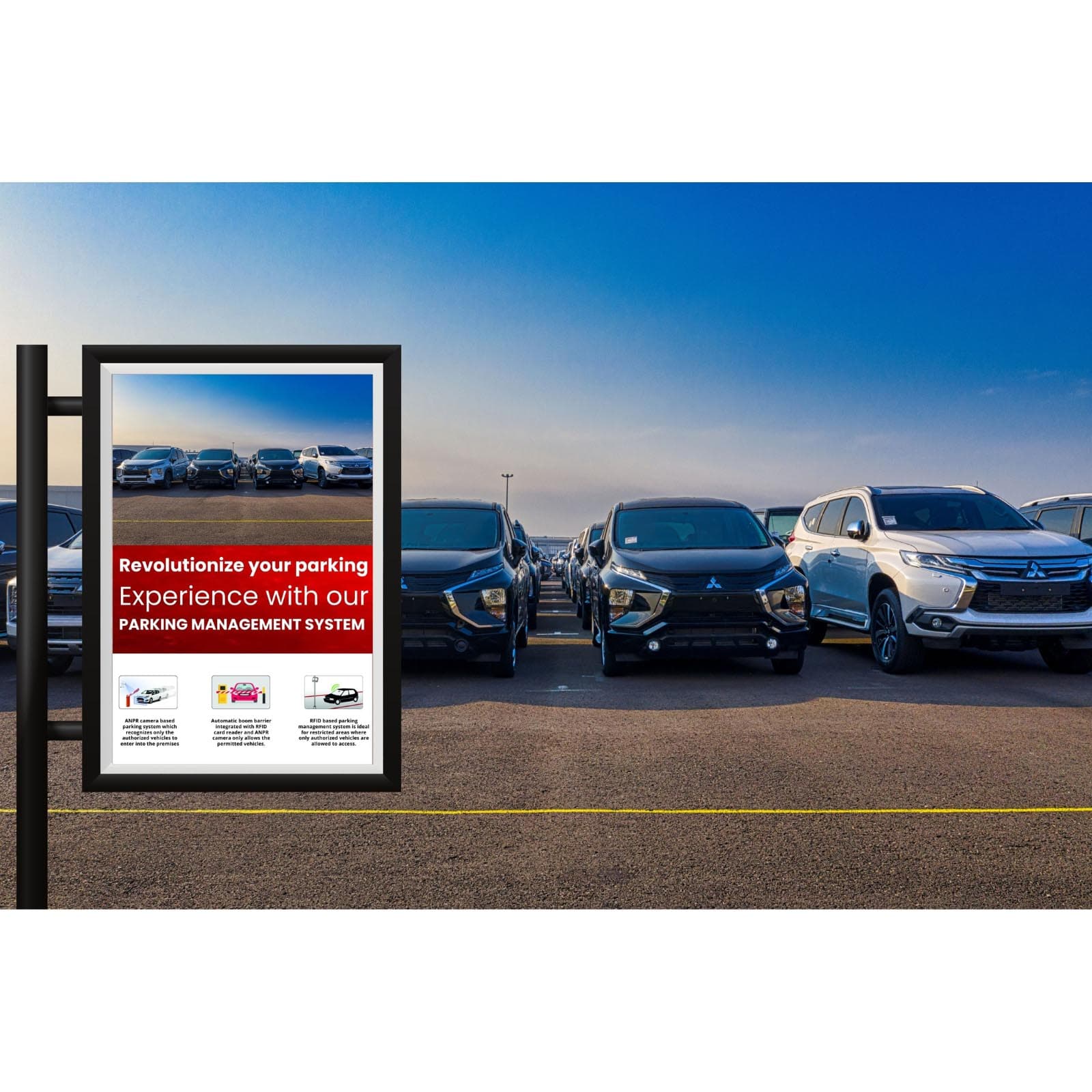
Shopping malls across Riyadh, Jeddah and other major Saudi cities rely on integrated parking management to handle high daily vehicle volumes, manage validated parking for shoppers, and provide real-time occupancy signage that improves the visitor experience.
Corporate offices use parking management solutions to manage employee and visitor vehicle access efficiently, often integrated with the same identity system used for building access.
Hospitals use parking management to separate staff, visitor and emergency-vehicle access clearly, ensuring critical lanes remain unobstructed while managing general visitor parking capacity.
Residential compounds use parking management, typically centred on UHF tag identification, to give residents fast automatic access while maintaining a complete log of vehicle movement for security.
Hotels use parking management for guest and event vehicle access, particularly properties that regularly host large functions requiring efficient, high-volume vehicle handling.
Airports and transit hubs use large-scale parking management solutions to handle continuous, high-volume vehicle turnover across extended operating hours.
TimeWatch Arabia begins every parking management deployment with a detailed site assessment, covering the number of lanes, expected daily vehicle volume, the mix of registered and visitor traffic, and any commercial requirements such as validation or payment integration. Based on this assessment, we specify the right combination of boom barriers, identification hardware and software modules.
Installation includes physical setup of all hardware, software configuration and integration, and testing of the full entry-to-exit workflow before go-live. Facilities and security staff are trained on day-to-day system management, including issuing and revoking vehicle tags, managing monthly-pass holders, and generating occupancy and usage reports.
Ongoing support covers hardware servicing, software updates, and expansion support as the facility adds lanes, gates or new access requirements over time.
The right parking management configuration looks quite different depending on the type of site being served, and understanding these common scenarios helps clarify what to specify. A residential compound typically prioritises fast, automatic resident access via UHF tags, with a simpler visitor process handled through an intercom or a manual guard log, since the commercial complexity of ticketing and payment is usually unnecessary in this context. A shopping mall, by contrast, typically needs full ticketing or ANPR-based entry for the large volume of daily visitors, alongside validation integration so retailers can offer free or discounted parking, and real-time occupancy signage to guide shoppers to available space efficiently.
Corporate and industrial campuses often sit between these two models, combining UHF-based employee access with a separate, more controlled visitor process that may include pre-registration and photo capture for security purposes. Hospitals typically require the most segmented approach of all, with clearly separated staff, visitor and emergency-vehicle lanes to ensure that critical access routes are never obstructed by routine visitor parking search traffic.
A common mistake in parking management deployment is under-specifying the software side while over-investing in barrier hardware, or the reverse. TimeWatch Arabia's approach treats hardware and software as a single specification exercise from the outset, ensuring the identification method, barrier configuration and reporting capability are matched to the site's actual commercial and operational model rather than assembled piecemeal after installation has already begun. A phased rollout is often the right approach for larger sites, starting with core entry and exit lanes and adding occupancy signage, validation integration or additional gates in a second phase once the base system is proven in daily operation.
TimeWatch Arabia designs, supplies and installs parking management solutions across all regions of Saudi Arabia, including Riyadh, Jeddah, Mecca, Medina, Dammam, Al Khobar, Dhahran, Jubail, Yanbu, Taif, Tabuk, Abha and Buraidah, with local installation and after-sales support wherever your site is located.
A typical solution combines automatic boom barriers at entry and exit lanes, vehicle identification via UHF RFID tags or ANPR cameras, ticketing or QR-based access for visitors, and central software for occupancy tracking, pass management and reporting.
A residential compound typically prioritises fast automatic resident access with simpler visitor handling, while a mall usually needs full ticketing or ANPR entry, validation integration and real-time occupancy signage. TimeWatch Arabia specifies the configuration based on your site's actual commercial model.
Yes. The software supports registered monthly-pass holders identified automatically via UHF or ANPR, alongside ticketed or QR-based access for visitors, within the same system.
Yes. Real-time occupancy and usage reports are available from the central dashboard, and occupancy data can also be displayed on entrance signage to guide incoming drivers.
In many cases, yes. TimeWatch Arabia can assess existing hardware and recommend an integration path, or specify new hardware where existing equipment is not compatible.
Yes. Parking management solutions from TimeWatch Arabia scale from a single-lane residential compound to a large, multi-level, multi-gate commercial facility.
Configuration — including the number of lanes, identification method and software features required — varies by site, so we recommend contacting TimeWatch Arabia directly for a tailored assessment and quote.
Yes. TimeWatch Arabia provides supply, installation, staff training and after-sales support for complete parking management solutions in all major regions of the Kingdom.
Yes, where compatible hardware is used. A single UHF tag or biometric credential can, in many deployments, be used for both vehicle access and building or attendance access, avoiding duplicate enrolment.
Yes. Occupancy signage is typically added once the underlying identification and software layer is in place, and TimeWatch Arabia can integrate signage into an existing parking management deployment as a later-phase addition.
Call: +966 53 915 7364
Email: sales@timewatcharabia.com