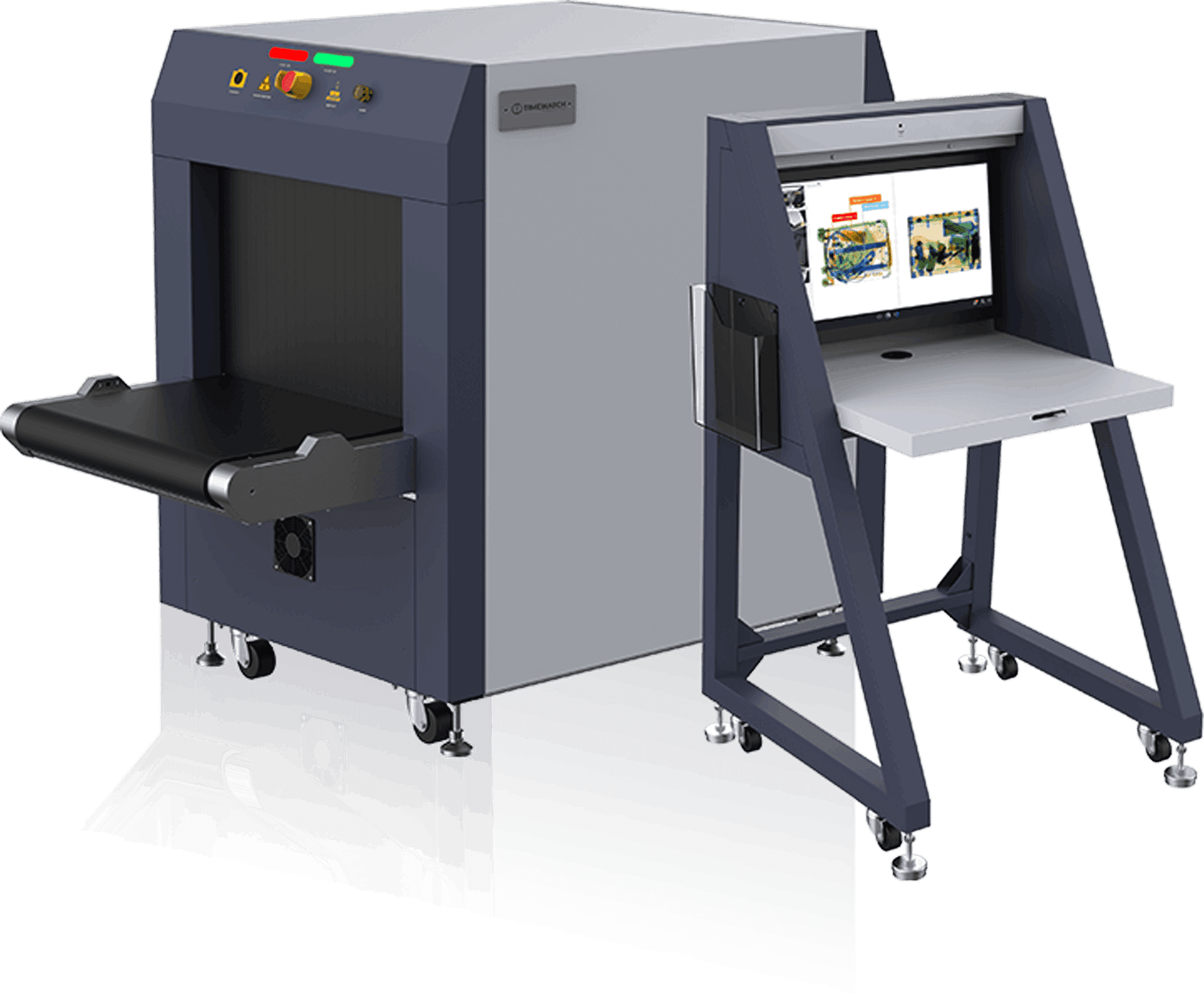
An X-ray baggage scanner screens bags, parcels and packages by passing them through an X-ray tunnel that produces a detailed internal image of their contents on a monitor, allowing security staff to identify prohibited or suspicious items without physically opening every bag. It is the standard tool used worldwide at building entrances, event checkpoints and logistics facilities wherever bag screening needs to be fast, non-intrusive and consistent.
TimeWatch Arabia supplies X-ray baggage scanners across Saudi Arabia, serving shopping malls, hotels, government buildings, logistics and courier hubs, and event venues that need reliable, high-throughput bag screening as part of their entrance security posture.
This page covers what an X-ray baggage scanner is, how the screening process works, the features that matter when specifying a unit for a Saudi site, why organisations choose TimeWatch Arabia, and the questions most commonly asked by security and procurement teams.
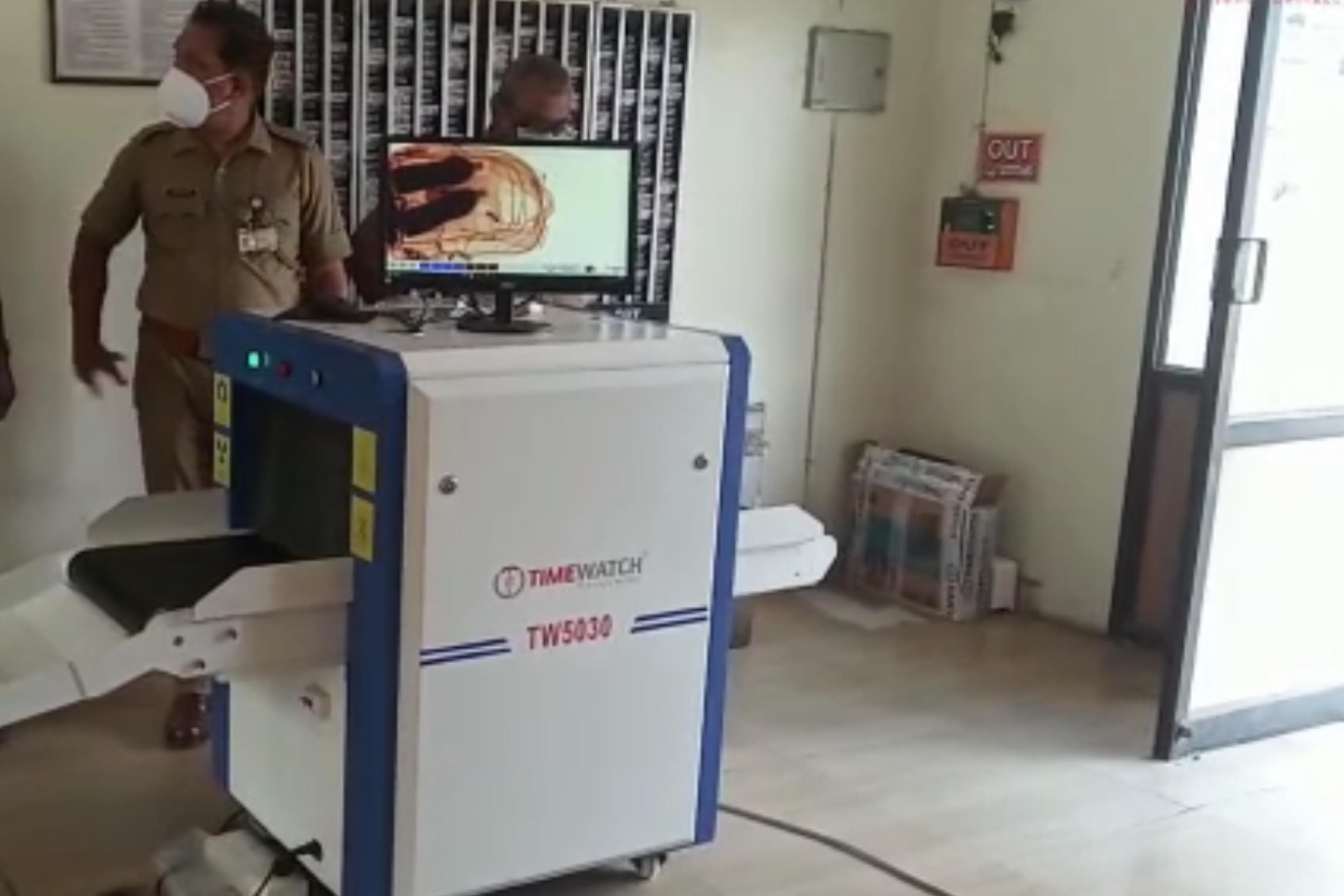
An X-ray baggage scanner is a self-contained unit consisting of a conveyor belt that carries a bag or parcel through a shielded tunnel, an X-ray generator that produces the imaging beam, and a detector array that converts the beam passing through the item into a digital image displayed on an operator monitor. The entire cabinet is shielded so that radiation does not escape beyond the tunnel opening, keeping the unit safe for continuous use by an operator standing beside it throughout a full working shift.
The resulting image typically uses colour coding to distinguish materials by density and composition — organic materials such as food or clothing typically render in one colour range, while metallic and other inorganic materials render in another — helping an operator quickly identify items that warrant a closer look, such as blades, tools, or other prohibited objects, without needing to physically search every bag that passes through.
Unlike a door frame metal detector, which screens a person directly, an X-ray baggage scanner screens what a person is carrying, and the two are frequently deployed together at the same checkpoint to provide complete coverage of both the individual and their belongings.
The process is designed to keep bag screening fast enough to avoid creating a bottleneck at busy entrances, while still giving the operator a clear, actionable image of every item that passes through.
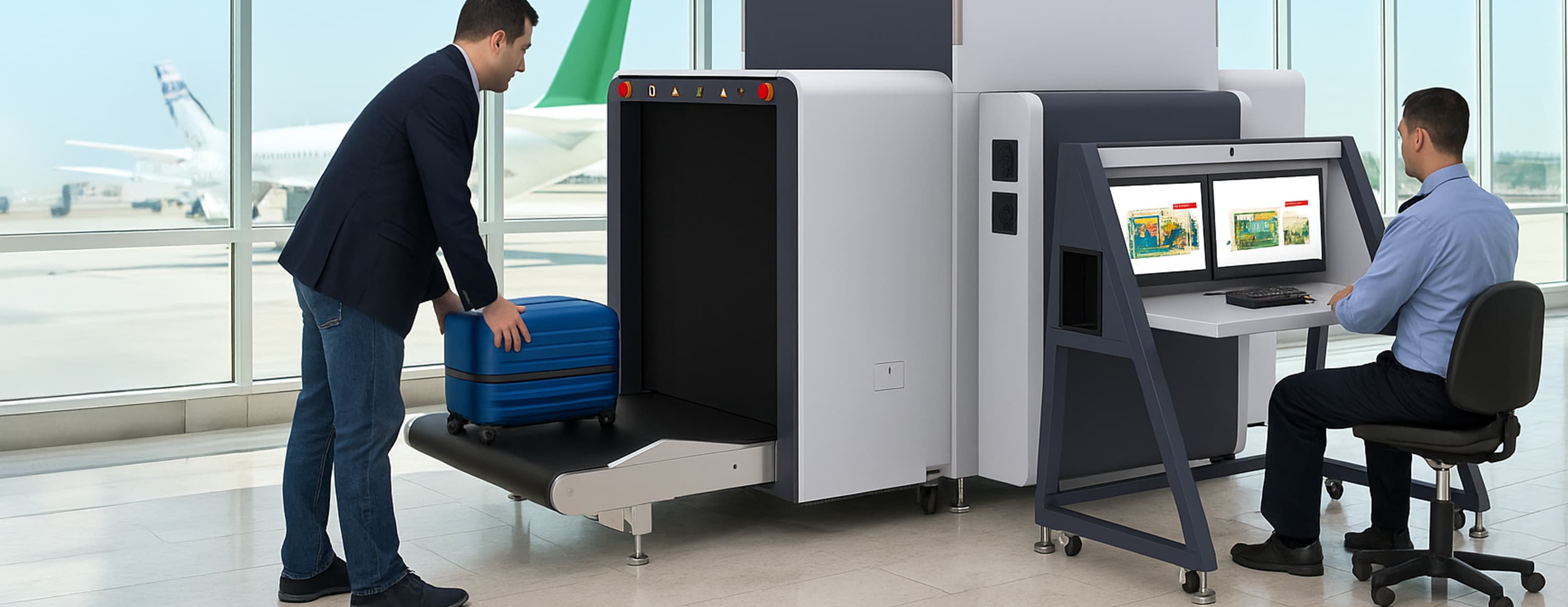
A bag or parcel is placed onto the entry end of the conveyor belt, which carries it at a steady pace into the shielded X-ray tunnel. Inside the tunnel, the X-ray source and detector array work together to build a complete image of the item's contents as it passes through, without requiring it to stop.
The image appears on the operator's monitor in real time, typically with tools allowing the operator to zoom into specific areas, adjust contrast, or toggle between colour and greyscale views to get a clearer look at a particular object. Modern units retain a short buffer of recent images so an operator can rewind and re-examine an item that has already passed through the tunnel if something catches their attention a moment too late.
If the operator identifies a prohibited or suspicious item, the bag is pulled aside for a manual check, either opened by security staff or the owner, depending on site protocol. Every scan can be logged, and image data can be stored for a defined retention period to support later review or audit if required by site policy.

Image resolution and material discrimination are the primary technical specifications that determine how easily an operator can distinguish between an innocuous item and a genuine concern. TimeWatch Arabia supplies units with high-resolution imaging that renders clear detail even for densely packed bags, along with colour-coded material discrimination to speed up visual interpretation.

Tunnel size is selected based on what the site actually needs to screen. A compact tunnel is well suited to handbags, laptop bags and parcels typical of an office or hotel lobby checkpoint, while a larger tunnel accommodates oversized luggage or bulkier packages typical of logistics and courier hubs. TimeWatch Arabia advises on the right tunnel size based on the site's actual traffic and item profile rather than defaulting to a single standard size for every deployment.

Image storage and review tools allow security teams to retain and revisit scan images for a defined period, which is useful both for internal audit and for cooperating with any investigation that may require historical scan records.

A compact footprint is available for sites with limited lobby space, such as hotel entrances or office receptions, without compromising on image quality.

Low radiation emission designed for continuous operator use is standard, keeping the unit safe for security staff working full shifts directly beside the machine.
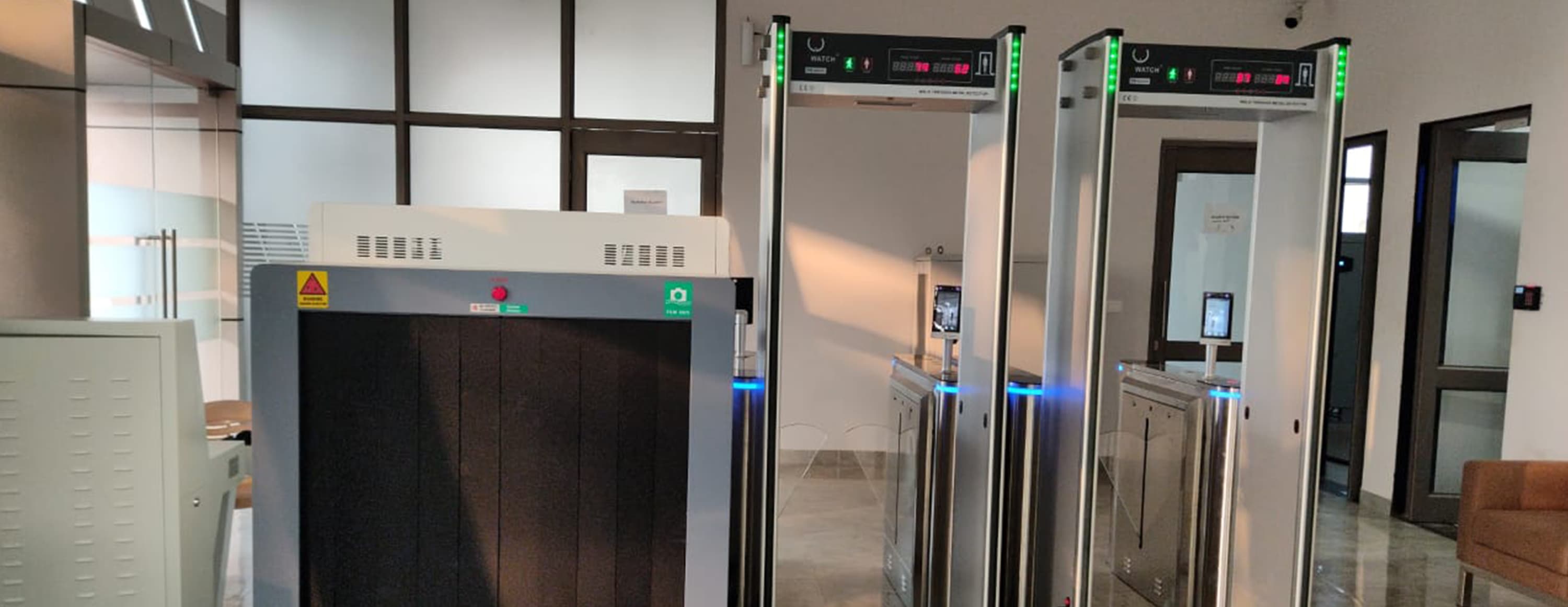
TimeWatch Arabia supplies X-ray baggage scanners as part of a complete entrance-security product range alongside door frame metal detectors, boom barriers and turnstiles, allowing a site to procure and coordinate its entire security checkpoint through a single, accountable supplier rather than juggling multiple vendors for individual components.
Every installation is supported by on-site setup, operator training on image interpretation and screening procedure, and local after-sales service across Saudi Arabia. Because operator skill has a direct impact on how effectively a scanner catches genuinely concerning items — a machine is only as good as the person reading its output — TimeWatch Arabia places particular emphasis on training security staff to read images confidently and consistently, not just on installing the hardware.
As a manufacturer and provider with a direct presence across the Kingdom, TimeWatch Arabia can respond quickly to servicing needs, firmware updates, or requests to add additional units as a site's security requirements grow, without the delay of routing every request through an overseas supplier.
TimeWatch Arabia also supports sites that are upgrading from an older or unreliable scanning unit, assessing what can be retained from an existing checkpoint layout and what should be replaced, rather than requiring a full checkpoint rebuild by default. This is a common scenario for hotels and malls that installed baggage screening some years ago and now find image quality, throughput or reliability no longer meets current visitor volumes, and a targeted upgrade path is often more practical than a complete replacement of the entire checkpoint.
Shopping malls and large retail complexes across Riyadh, Jeddah and other major Saudi cities use X-ray baggage screening at main entrances, particularly during high-footfall periods, to maintain a safe shopping environment without creating long queues at the door.
Hotels use baggage screening at guest and service entrances as part of a broader hospitality security posture, especially properties that regularly host large events, conferences or VIP guests.
Government offices and courts across the Kingdom deploy baggage screening as a routine part of visitor and staff access control, frequently paired with DFMD screening for complete checkpoint coverage.
Logistics and courier hubs use higher-throughput units to screen parcels efficiently as part of security or compliance procedures before onward transport.
Event venues and stadiums rely on X-ray screening at multiple entrance gates to process bags from large crowds arriving within a short window ahead of an event.
Corporate headquarters, particularly in sectors with heightened security requirements, use baggage screening at staff and visitor entrances as a standard part of building access policy.
TimeWatch Arabia begins each installation with a site assessment to determine the right tunnel size, throughput capacity and lobby placement for the specific entrance being secured. Installation includes physical positioning, power connection, calibration, and integration into the site's overall checkpoint layout alongside any DFMD or turnstile equipment already in place.
Operator training covers not just how to operate the console, but how to read and interpret images confidently — recognising common shapes and materials, using zoom and contrast tools effectively, and following the site's escalation procedure when a concerning item is identified. This training is a core part of every TimeWatch Arabia deployment, not an optional add-on.
Ongoing support includes servicing, calibration checks and software updates, ensuring the unit continues to deliver clear, reliable imaging over years of daily use in Saudi Arabia's operating conditions.
The right specification for an X-ray baggage scanner depends on three practical factors that TimeWatch Arabia assesses during every site visit: the type and size of items that need to be screened, the volume of traffic expected at peak times, and the available space in the lobby or checkpoint area. A hotel or office lobby typically needs a compact unit sized for handbags, laptop bags and small parcels, positioned discreetly without dominating the entrance. A logistics hub or courier facility, by contrast, needs a larger tunnel capable of handling oversized packages and a higher sustained throughput, since the screening station there is often a continuous operational chokepoint rather than an occasional checkpoint.
Image resolution requirements also vary by application. A general visitor-screening checkpoint benefits from clear, colour-coded imaging that lets an operator make a fast visual judgement, while a higher-security government or logistics application may warrant a higher-resolution unit that renders finer detail for closer inspection of complex or densely packed items. Getting this specification right the first time avoids the common and costly mistake of under-speccing a unit that then becomes a bottleneck once real-world traffic volumes are understood.
Operator staffing model matters too. A checkpoint with one operator reviewing images throughout a full shift needs a unit engineered for continuous low-radiation operation directly beside the machine, while some larger facilities rotate operators between the scanner console and other duties, which changes the training emphasis. TimeWatch Arabia factors the intended staffing model into both the hardware specification and the training programme delivered at installation.
TimeWatch Arabia supplies and installs X-ray baggage scanners across all regions of Saudi Arabia, including Riyadh, Jeddah, Mecca, Medina, Dammam, Al Khobar, Dhahran, Jubail, Yanbu, Taif, Tabuk, Abha and Buraidah, with local installation, operator training and after-sales support wherever your site is located.
Yes. Units are shielded to prevent radiation escaping beyond the tunnel opening and are engineered for continuous operator use throughout a full working shift, in line with standard radiation-safety design principles.
TimeWatch Arabia assesses the type and volume of items you expect to screen, along with your available lobby space and staffing model, and recommends the tunnel size and resolution that matches your real-world traffic rather than a generic default.
It depends on the type and volume of items you need to screen. Compact tunnels suit handbags and parcels typical of an office or hotel lobby, while larger tunnels suit oversized luggage or bulk parcels typical of logistics hubs. TimeWatch Arabia recommends the right size after assessing your site.
Yes. Image storage and review tools allow scan images to be retained for a defined period and revisited for audit or investigation purposes in line with site policy.
Yes. Colour-coded imaging highlights differences between organic and inorganic materials, helping operators quickly identify items that need a closer look.
Properly specified units, sized to the site's actual traffic volume, are designed to keep throughput high, and pairing screening with well-trained operators keeps the process moving smoothly even during peak periods.
Configuration — including tunnel size, resolution and throughput requirement — varies by site, so we recommend contacting TimeWatch Arabia directly for a tailored assessment and quote.
Yes. Operator training on image interpretation and screening procedure is a core part of every deployment, since how effectively a scanner performs depends heavily on the operator reading its output.
Yes. Many sites pair an X-ray baggage scanner with a door frame metal detector to screen both a visitor and their belongings at the same checkpoint, and TimeWatch Arabia can supply and install both together as a coordinated solution.
Call: +966 53 915 7364
Email: sales@timewatcharabia.com