
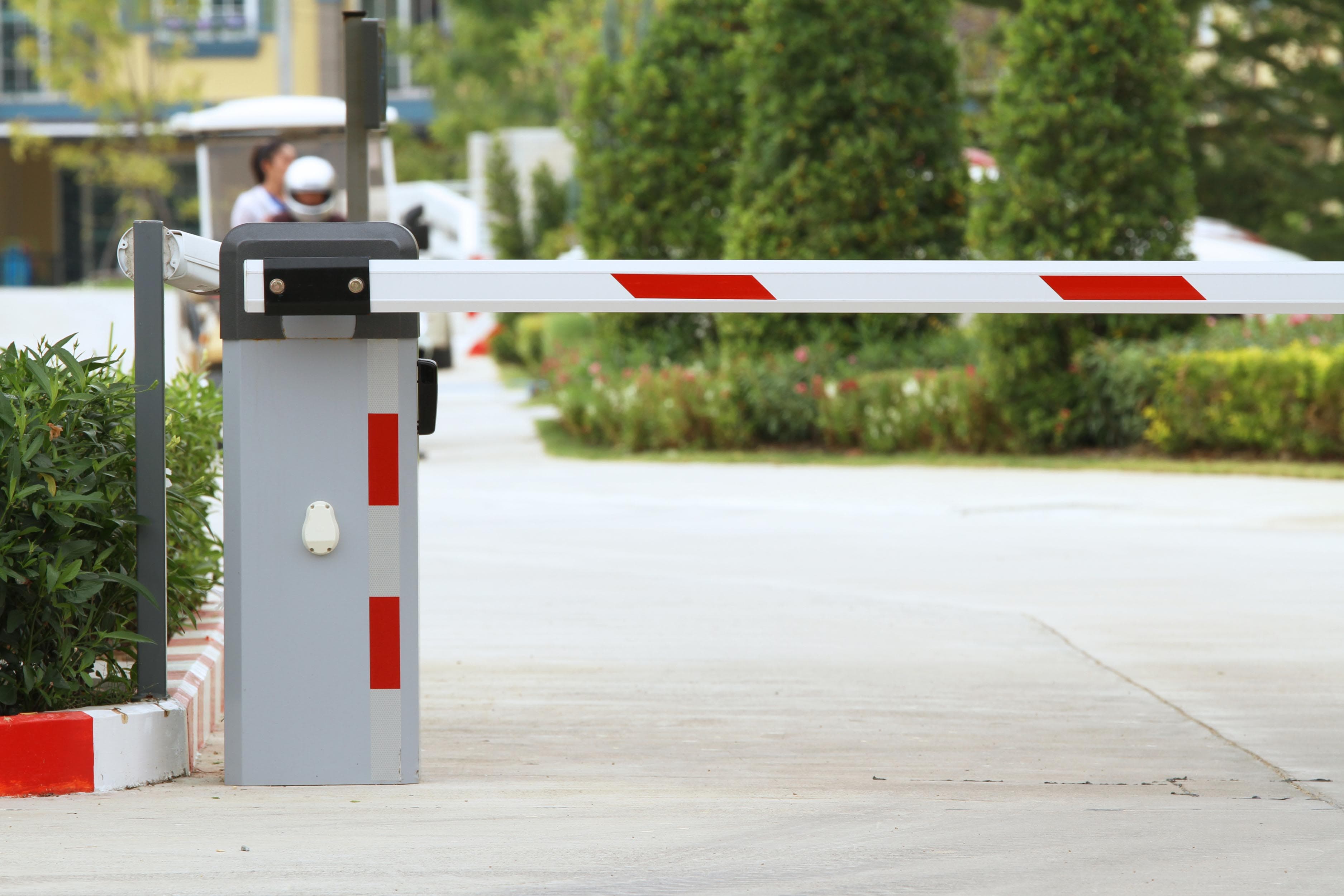
How Does a Boom Barrier Work?
What Is a Boom Barrier?
A boom barrier (also called a barrier gate or boom gate) governs vehicle movement at a single controlled point. In the Kingdom you meet them at compound gates in Riyadh, at refinery and plant entrances in the Eastern Province, at port truck lanes, at hospital and university approaches, and on the pilgrim transport routes around Makkah and Madinah. The device is the same everywhere; what differs is the traffic pattern it is asked to handle and the climate it is asked to survive.
It is important to be precise about what the equipment is for. A boom barrier is a traffic control and access recording device, not a vehicle impact protection device. The arm will not physically stop a vehicle driven at it. What it provides is a controlled, auditable decision point: nothing passes until the system has established that it is permitted to, and every passage is written to a log. That distinction drives a great many specification decisions on secure sites in Saudi Arabia, and this page returns to it at the end.
How Does a Boom Barrier Work?
A boom barrier works in four stages. A sensor detects that a vehicle has arrived. An access method authorises it, an RFID tag, a recognised number plate, a ticket, or a guard pressing a button. The controller then drives a motor and gearbox that rotate the boom arm to the vertical position, where a limit switch or encoder stops it. After the vehicle passes, a safety loop or photocell confirms the lane is clear, and the controller lowers the arm.
Detect, authorise, drive, confirm, close. Everything else on this page is detail sitting beneath those five words, including the environmental engineering that decides whether the sequence still runs reliably at two in the afternoon in July.
Main Components of a Boom Barrier
| Component | Function |
|---|---|
| Barrier housing (cabinet) | Weather-resistant steel or aluminium enclosure holding the drive assembly, controller and manual release. The ingress protection rating and the coating system of this enclosure carry more weight in Gulf conditions than in temperate climates. |
| Drive unit | Electric motor with a gearbox (electromechanical), or a pump and cylinder (hydraulic), providing the torque that turns the arm. |
| Crank and linkage | Converts the drive unit's rotation into the arm's 90-degree sweep. |
| Balance spring | A torsion or tension spring counterbalancing the arm's weight, so the motor moves a near-balanced load rather than lifting the full arm mass. Correct spring tension is central to smooth operation and motor life. |
| Boom arm | Aluminium octagonal, round or rectangular section, typically 3 to 6 metres. Optional skirt fencing, articulated joint for low headroom, or LED strip for night visibility. |
| Controller / control board | The logic of the system. Accepts open, close and safety inputs, drives the motor, manages timers, and communicates with access control or parking software. |
| Limit switches or encoder | Tell the controller when the arm has reached fully open or fully closed so the motor stops at the right point. |
| Loop detector | Electronics that sense a vehicle over a wire loop cut into the road surface. |
| Photocell / infrared beam | An optical beam across the lane that halts or reverses the arm if the path is obstructed. Lens contamination is the most frequent cause of nuisance faults on dusty sites. |
| Access control input | RFID reader, ANPR camera, ticket dispenser, push button, remote control or intercom, whatever grants the authorisation. |
| Manual release | A key-operated mechanism that disengages the drive so the arm can be raised by hand during a power failure. |
| Ventilation and thermal management | Filtered vents or a sealed-convection housing that keeps the drive electronics within their rated temperature band. On an outdoor Saudi gate this is a functional component, not a detail. |
Drive unit and gearbox
Most barriers in commercial use are electromechanical: an AC or brushless DC motor turning a worm or helical gearbox. The gearbox provides the reduction that turns a fast, low-torque motor output into slow, high-torque arm movement, and its self-locking characteristic helps hold the arm in position. Higher-duty models use brushless DC motors with soft start and soft stop, which reduces mechanical shock at each end of travel and extends service life in lanes cycling thousands of times a day.
Brushless units also tend to behave better thermally, because there is no brush friction adding heat inside an enclosure that is already sitting in direct sun. On high-throughput Saudi gates this is usually the deciding factor rather than a refinement.
Boom arm and balance spring
The balance spring is the component most often misunderstood. It is not a safety device; it is a counterweight. Set correctly, the arm is close to neutrally balanced through its travel, so the motor does far less work and the barrier moves smoothly. Set incorrectly (commonly after an arm is replaced with one of a different length) the motor labours, travel becomes uneven, and the drive wears prematurely. Any change of arm length requires the spring tension to be reset.
Arm replacement is more common in the Kingdom than many operators expect, because wide industrial and port lanes attract long arms, and long arms attract vehicle strikes. Every such replacement is a spring-tension event.
Controller and position sensing
The controller decides what happens and when. It holds the open and close timers, the logic for which inputs are permitted to trigger movement, the response to each safety device, and the interface to external systems. Position is confirmed either by mechanical limit switches at each end of travel or, on newer units, by an encoder reading the drive shaft continuously, which also allows the controller to detect that the arm has stalled against an obstruction.
Detection and safety devices
These are covered in full in the two sections below, but the principle is worth stating early: detection devices decide when to open, safety devices decide when it is not permitted to close. Conflating the two is a common specification error, and it is the error that produces a barrier that works perfectly in commissioning and strikes a vehicle in week three.
How Does a Boom Barrier Work Step by Step?
| Step | What happens | How it works |
|---|---|---|
| 1 | Vehicle approaches and is detected | An inductive loop buried in the road, or an IR, radar or camera sensor, registers the vehicle's presence at the entry point. |
| 2 | Credential is presented and read | A UHF RFID tag on the windscreen is read at range, a camera reads the number plate, a ticket is taken, a card is tapped, or a guard presses the open button. |
| 3 | Authorisation is decided | The credential is checked against the permitted list held in the controller, access control panel or parking software. A valid match produces an open command; an invalid one does not, and is logged as a denied attempt. |
| 4 | Controller energises the drive | The control board switches power to the motor. Soft start ramps it up to avoid jerking the arm. |
| 5 | Arm rotates to vertical | The gearbox and crank convert rotation into the arm's upward sweep, assisted by the balance spring. Typical travel is 1.5 to 6 seconds depending on arm length and model. |
| 6 | Open position is confirmed | A limit switch or encoder tells the controller the arm has reached full open, and the motor is stopped. |
| 7 | Vehicle passes through | The safety loop beneath the arm, and the photocell across the lane, both register the vehicle in the passage zone. |
| 8 | Lane is confirmed clear | The controller waits until the safety loop de-energises and the photocell beam is unbroken, meaning no vehicle remains under the arm. |
| 9 | Close is triggered | Either immediately on the lane clearing, or after a configured delay, or on an exit loop being crossed, depending on how the site is set up. |
| 10 | Arm lowers and the event is logged | The arm returns to horizontal and stops at the closed limit. The passage (credential, direction, timestamp, lane) is written to the access control or parking database. |
If an obstruction is detected at any point during step 10, the controller immediately stops and reverses the arm. This is the single most important behaviour in the cycle and is covered below. Note also that steps 4 to 6 are the thermally demanding part of the sequence: every repetition puts current through the motor and heat into the housing, which is why the cycle rate a barrier can sustain depends on the air temperature around it.
How the Barrier Knows a Vehicle Is There
Inductive loop detectors
The inductive loop is the most widely used vehicle detector on controlled lanes, and the least visible, it sits inside the road surface. A loop of wire is cut into the asphalt or concrete in a rectangular or diagonal pattern and connected to a detector card. The card drives a small alternating current through the loop, which forms an oscillating circuit with a characteristic frequency.
When a large metal mass (a vehicle body) enters the loop's field, eddy currents induced in the metal alter the loop's effective inductance, shifting that frequency. The detector card senses the shift and outputs a presence signal. It detects the vehicle's metal mass, not its weight, which is why loops reliably detect cars and trucks but may not register a person or a bicycle.
A typical lane uses more than one loop with distinct jobs: an arming loop ahead of the barrier to wake the system or trigger the reader, a safety loop directly under the arm to prevent closing on a vehicle, and sometimes an exit loop past the barrier to confirm the vehicle has fully cleared and trigger the close.
RFID and long-range readers
For residential compounds, ministry and corporate campuses, and industrial sites where the same fleet returns every day, UHF RFID is the usual method. A passive tag (a windscreen sticker or a hard tag) carries an identifier but no battery. The reader's antenna radiates RF energy; the tag harvests enough of it to power its chip and reflect back its ID. Read ranges of several metres mean the vehicle is identified while still approaching, so the barrier is already opening as the driver arrives and no window needs to be lowered.
That last point is not a convenience feature in a Saudi summer. A gate design that requires drivers to open a window and present a card at every entry puts the reader, the driver and the queue behind them under avoidable strain during the hottest hours. Long-range identification keeps cabins closed and lanes moving.
ANPR number plate recognition
Automatic Number Plate Recognition uses a camera and optical character recognition to read the plate itself. An infrared-illuminated camera captures the plate (IR is used because retroreflective plates return it strongly and it works in darkness) and software locates the plate within the frame, segments the characters and converts them to text. That text is checked against the permitted list.
ANPR needs no tag in the vehicle, which makes it well suited to visitor traffic and to sites where issuing tags is impractical. Saudi plates carry both Arabic and Latin character sets, so the recognition engine must be configured for the dual-script plate format rather than a generic Latin-only model; that is a configuration decision at commissioning, not something to discover in service. Accuracy also depends on camera angle, mounting height, illumination, vehicle speed and plate condition. Low-angle sun, heat shimmer rising off asphalt in the afternoon, and a film of dust on the camera window are the three local factors that most often degrade read rates, so most sites run ANPR alongside a fallback (an intercom, a guard, or a ticket) rather than relying on it alone.
Tickets, intercom and manual operation
Public and commercial car parks commonly issue a ticket or token at entry, which carries the entry timestamp for later tariff calculation by the operator's system. Where traffic is low, highly varied, or seasonal (a facility that is quiet for ten months and then handles pilgrim coach movements for several weeks) manual operation by a guard using a push button, remote handset or intercom remains entirely legitimate. Every automatic barrier retains a manual override for exactly this reason, and on event-driven sites that override is used far more than the specification anticipates.
How Desert Conditions Affect Boom Barrier Specification
This is the section that separates a barrier that works for eight years from one that becomes a recurring complaint in its first summer. The mechanism described above does not change in Saudi Arabia (physics is physics) but the operating envelope around it does, and the specification has to account for it explicitly.
Ambient temperature and duty cycle derating
Every barrier motor is rated for a duty cycle: the proportion of time it can run within a given period without exceeding its thermal limits. That figure is always quoted against a reference ambient temperature, commonly 20 to 25 °C in a European catalogue. It is a thermal statement, not a mechanical one: the motor can keep cycling as long as it can shed heat as fast as it generates it.
Across much of the Kingdom, summer shade temperatures routinely sit above 45 °C and inland sites regularly approach or pass 50 °C. Inside a dark enclosure in direct sun, the air around the motor is hotter still. The motor is now trying to dump heat into air that is already close to its own limit, so the amount of heat it can shed per cycle falls sharply. The practical consequence is simple and frequently missed: the permissible cycle rate falls as ambient temperature rises. A barrier whose catalogue states, for example, a high duty figure at 25 °C will not sustain that same figure at 50 °C. It will reach its thermal cut-out, pause, and leave a queue standing at the gate, exactly at the busiest hour of a hot afternoon.
Specifying around this is called derating, and it is done at design stage:
- Establish the real peak throughput of the lane in vehicles per hour, measured at the busiest period rather than averaged across the day.
- Take the manufacturer's duty figure together with its stated reference ambient and its maximum operating temperature.
- Select a unit whose rated duty at the site's design ambient, not at the catalogue ambient, still exceeds peak demand with headroom. Asking the manufacturer for duty against temperature, rather than a single headline number, is a reasonable and normal request.
- Where the figure is marginal, move up to a heavy-duty or hydraulic unit, or split the flow across two lanes so neither is loaded to its thermal limit.
Physical measures reduce the derating required. Shading the barrier housing under the gatehouse canopy, choosing a light-coloured housing finish over a dark one, keeping ventilation paths genuinely clear, and avoiding installations where the cabinet sits against a sun-heated wall all lower the air temperature the motor actually experiences. None of these are exotic; they are simply decisions that have to be taken before the plinth is poured.
Sand and dust as the dominant wear mechanism
In temperate installations, rain and corrosion are the principal environmental enemies. In Saudi Arabia, airborne sand and dust take that place by a wide margin, and they attack a barrier on four distinct fronts.
- Abrasion of seals and bearings. Fine wind-borne particles are hard and angular. Where they reach a rotating shaft seal or a bearing surface they act as a grinding compound, wearing the seal and letting more particles in, a process that accelerates once it starts. Shaft seal quality and bearing sealing are therefore first-order specification items, not minor ones.
- Clogged ventilation. Dust accumulating in vents and on any filter directly reduces the airflow the thermal design assumed. This compounds the temperature problem above: a barrier that was adequately derated on day one quietly loses margin as its vents load up, and the first symptom is a thermal trip at peak hour.
- Contaminated photocell lenses. A film of dust on a transmitter or receiver lens attenuates the infrared beam. Attenuate it enough and the receiver reads the beam as broken, so the controller refuses to close the arm, or reverses mid-travel, with no obstruction present. False obstruction detection on dusty sites is far more often a dirty lens than a faulty sensor, and the fix is a cloth rather than a replacement board.
- Ingress into the control enclosure. Dust settling on electronics is insulating; it traps heat on components that need to shed it, and in humid coastal air it draws moisture and becomes conductive across tracks.
Because of this, the IP rating of the housing matters far more here than in a temperate climate, and the first digit (the solid-particle digit) is the one to read. Enclosures rated for dust-protected or dust-tight service, with gasketed doors and sealed cable entries, are the sensible baseline for exposed outdoor gates. It is also worth confirming that the rating applies to the enclosure as installed, with its door closed and its glands fitted correctly, because an IP-rated cabinet commissioned with an open gland plate is not IP-rated at all.
Loop installation in high surface temperatures
Loop detection is reliable technology that fails for workmanship reasons, and in the Kingdom two of those reasons are specifically climatic.
The first is sealant selection. The loop slot is cut, the wire laid, and the slot filled with a sealant that must remain flexible so the wire is not stressed as the road moves. Road surface temperatures in direct summer sun run far above the air temperature. A sealant that cures hard, or that softens and flows at those surface temperatures, will either crack and admit water and grit or will migrate out of the slot and leave the wire exposed. A sealant specified for the actual surface temperature range of a Saudi carriageway, and applied within its stated application window, is what the design calls for.
The second is asphalt movement. Bitumen softens in extreme heat. Under heavy, slow-moving traffic at a gate (loaded trucks at a port or industrial lane, coaches at a transport hub) softened asphalt deforms, rutting and shoving around the point where vehicles brake and turn. That movement works the loop wire, stretches it, and can break the conductor or chafe its insulation. The result is an intermittent loop that behaves differently in the afternoon than it does at dawn, which is one of the harder faults to diagnose if the cause is not already in mind.
The practical responses are to cut loops in sound, properly compacted surfacing rather than in patched or rutted material; to prefer concrete aprons at the barrier itself on heavy-vehicle lanes; to use stranded, correctly insulated loop wire with the specified number of turns; to twist the feeder tails properly from the slot to the detector; and to re-test loop continuity and insulation resistance after any resurfacing or patching work. Where asphalt movement is an ongoing fact of life, above-ground detection (infrared, radar or camera-based) is a legitimate alternative to cutting the road repeatedly.
Coastal humidity and salt corrosion
Inland and coastal sites in the Kingdom are different corrosion environments, and specifying them identically is a mistake in both directions. Inland, at Riyadh or Tabuk, the air is dry and corrosion is slow; the dominant problem is heat and abrasive dust. Along the Red Sea coast at Jeddah and Yanbu, and along the Arabian Gulf at Jubail, Dammam and Al Khobar, humidity is high for much of the year and the air carries salt aerosol. Salt is hygroscopic: it draws moisture out of humid air and holds a conductive electrolyte film against metal surfaces, long after any visible wetting has gone. That film drives rapid corrosion of carbon steel and attacks fasteners, hinges, exposed welds and cut edges first.
For a coastal gate, corrosion protection therefore has to be specified rather than assumed:
- Hot-dip galvanised steel substrate, or a duplex system of galvanising plus a polyester powder coat, in place of a bare powder coat over mild steel.
- Stainless fasteners of an appropriate grade, and attention to avoiding dissimilar-metal contact that can set up galvanic corrosion at joints.
- Sealed cable glands, and conduit and gland materials chosen for marine exposure.
- Foundation detailing that drains rather than ponds, so the base of the housing is not standing in salt-laden water after a wash-down.
- Routine fresh-water rinsing of the housing exterior at coastal sites, which removes accumulated salt before it has time to work.
The same logic extends to the electronics. A conformally coated control board resists a humid salt environment considerably better than an uncoated one, and on a coastal installation that is a reasonable thing to ask about during technical evaluation.
Setting intervals from conditions, not from a calendar
A generic service schedule (a fixed number of visits per year) is a poor fit for this environment, because the two variables that actually drive wear are cycle count and exposure, and both vary enormously between sites in the same city. A barrier on a quiet ministry staff gate in Riyadh and a barrier on a truck lane at an Eastern Province plant are not on the same maintenance curve.
A workable approach is to set the interval from the site rather than from the equipment:
| Site condition | Dominant stress | Attention pattern typically suited to it |
|---|---|---|
| Inland, high daily cycle count, exposed to open desert (industrial or logistics gate) | Thermal load plus abrasive dust | Short intervals. Vent and filter cleaning, photocell lens cleaning and drive inspection far more often than a standard schedule assumes; dust accumulation should be treated as a scheduled item in its own right. |
| Inland, moderate cycle count, within a built compound | Dust, moderate thermal load | Standard mechanical servicing, with lens cleaning added at a shorter interval than the main service. |
| Coastal, any cycle count | Salt-laden humidity plus dust | Corrosion inspection of housing, fasteners and cable entries at each visit, fresh-water rinsing between visits, and early attention to any coating damage before it spreads. |
| Event-driven or seasonal (pilgrim transport, exhibition and stadium parking) | Long idle periods then sustained peak load | A pre-season commissioning check that fully exercises the barrier, the safety devices and the manual release before the peak, rather than a visit at a fixed calendar date. |
| Site adjacent to construction or active earthworks | Very high particulate load | Temporary short-interval cleaning for the duration of the works, reverting afterwards. Common on new developments where the gate is live before the surrounding site is complete. |
After a shamal or any significant dust event, an additional inspection is justified regardless of where the site sits in its schedule. Lenses, vents and the arm's reflective markings are the items to check first, and all three take minutes.
Electromechanical vs Hydraulic Boom Barriers
| Aspect | Electromechanical | Hydraulic |
|---|---|---|
| Drive method | Electric motor turning a gearbox and crank | Electric pump driving hydraulic fluid through a cylinder |
| Typical application | Compound gates, offices, staff parking, most commercial lanes | Long arms, very high duty cycles, industrial, port and toll lanes |
| Arm length suitability | Shorter to medium arms | Handles longer and heavier arms more comfortably, relevant on the wide lanes common at Saudi industrial and port gates |
| Duty cycle | Suits low to medium cycling; heavy-duty variants available | Typically suited to continuous, high-frequency operation |
| Behaviour at high ambient temperature | Thermal limit is set by motor heat rejection; derating at 45-50 °C must be checked explicitly | Fluid viscosity and seal rating become the temperature-sensitive items; confirm the fluid specification and seal compound against the site's temperature range |
| Maintenance profile | Mechanical wear points: gearbox, spring, limit switches | Fluid level and condition, seals and hoses in addition to mechanical checks |
| Behaviour on power loss | Manual release key disengages the drive | Manual release valve bleeds pressure to free the arm |
Selection is driven by arm length, cycles per day and the operating environment, not by a general notion that one type is superior. A refinery truck gate in Jubail cycling heavy vehicles through a wide lane all day and a staff entrance at a Riyadh office compound are genuinely different specification problems, and the honest answer is that each has a different correct unit.
How Boom Barrier Safety Systems Work
Because the arm moves through a space that vehicles and people occupy, layered protection is standard. Each layer works differently, which is why competent installations use more than one.
- Safety loop: the loop directly beneath the arm. While it senses a vehicle, the controller is inhibited from closing. This is a presence interlock rather than a reaction: it prevents the close command rather than interrupting one.
- Photocell / infrared beam: a transmitter and receiver across the lane. If the beam is broken while the arm is lowering, the controller stops and reverses it. This catches what a loop cannot, including pedestrians and low-metal objects. Modulated photocells are used so that strong ambient infrared (and direct desert sunlight is a powerful infrared source) is not mistaken for the beam.
- Obstruction detection at the drive: the controller monitors motor current or encoder feedback. A sudden rise in load, or travel that stops when it should not have, is read as an impact and triggers a reverse.
- Manual release: allows the arm to be raised by hand in a power failure, so a lane never becomes permanently blocked. On sites with large numbers of people present, the release key must be where the guard on duty can reach it immediately, not in an office across the compound.
- Fire alarm interface: a dry contact from the fire panel that drives all barriers to open and hold, clearing egress routes during an evacuation. On any occupied site this integration should be treated as essential. In Saudi Arabia, life-safety arrangements of this kind fall within the remit of the General Directorate of Civil Defense, and the interface should be designed in from the start rather than retrofitted.
One local note on safety devices: because dust-related false triggers are common, there is a standing temptation on site to bypass a troublesome photocell to stop the nuisance reversals. That converts a maintenance task into a safety hazard. The correct response to a photocell that keeps triggering is to clean and realign it, and to shorten the cleaning interval, never to disable it.
Technologies Used in a Boom Barrier System
A modern barrier lane brings together several distinct technologies:
- Electromagnetic induction: loop detectors sensing vehicle presence through inductance shift.
- Passive UHF RFID: backscatter communication between reader antenna and unpowered windscreen tag.
- Optical character recognition with IR illumination: ANPR reading number plates in daylight and darkness, configured for the dual-script Saudi plate format.
- Motor control electronics: soft start and soft stop, current monitoring, thermal protection, and on some models variable-frequency drive.
- Position feedback: mechanical limit switches or rotary encoders confirming arm position.
- Optoelectronic sensing: modulated infrared photocells resistant to ambient light interference.
- Enclosure engineering: ingress protection, gasketing, filtered or sealed ventilation, and coating systems selected for the site's thermal and corrosion exposure.
- Network communication: TCP/IP, RS-485 or dry-contact interfaces to access control, parking and surveillance platforms.
Where Boom Barriers Are Used in Saudi Arabia
Vehicle access control in the Kingdom spans a set of applications that would be unusual to find together anywhere else, from giga-scale new-build developments to seasonal movements of several million people.
- Vision 2030 developments and new urban districts: large master-planned projects generate barrier requirements in phases: first at construction and logistics gates where the dominant conditions are heavy vehicles and extreme particulate load, then at the permanent gates of the completed development where the requirement shifts to residential, retail and staff traffic with full access control integration. Planning for both phases in the original design avoids a complete replacement between them.
- Oil, gas and petrochemical facilities: plant perimeters and process-area gates, where vehicle access is recorded against a permit-to-work regime and where contractor fleets, tanker movements and shift changes produce sharply peaked traffic. The industrial cities of Jubail and Yanbu concentrate this requirement, with wide heavy-vehicle lanes, long arms and duty cycles that have to be sized for peak shift movement rather than daily average.
- Pilgrim infrastructure at Makkah and Madinah: Hajj and Umrah produce vehicle and pedestrian volumes with very few parallels anywhere in the world, concentrated into defined periods and defined corridors. Barrier systems on these routes serve a crowd-management function as much as a security one: they enforce the segregation of vehicle routes from pedestrian areas, control coach and shuttle movements into staging areas in sequence, hold vehicles outside zones where people are moving on foot in large numbers, and provide the controlled release points that allow transport operations to be metered rather than arriving all at once. The requirements that follow are specific, very high reliability during the peak, equipment that has been fully exercised before the season begins rather than at the start of it, clear interface with traffic management and the authorities directing the operation, unambiguous emergency-open behaviour, and lanes whose geometry suits coaches rather than cars.
- Ports and logistics: Jeddah Islamic Port on the Red Sea and King Abdulaziz Port at Dammam on the Gulf run container and truck gates where the barrier sits within a wider gate process: identification of the vehicle and driver, document and booking verification, weighbridge, and release. Wide lanes, continuous duty, heavy vehicles and salt-laden coastal air combine every demanding factor on this page in a single installation.
- Government and ministry compounds: controlled, recorded entry with staff and visitor traffic separated, typically with the boom barrier handling flow in front of crash-rated equipment that provides the protective line.
- Universities, schools and research campuses: large sites in Riyadh, Jeddah, Dhahran and Abha with concentrated arrival and departure peaks around timetables, and a need to separate staff, student and visitor parking.
- Hospitals and medical cities: separating ambulance routes from general and staff parking, with priority opening for emergency vehicles and an absolute requirement that a failed barrier never blocks an emergency approach.
- Retail and mixed-use developments: high-turnover public parking at malls and mixed-use schemes in Riyadh, Jeddah and across the Eastern Province, usually with ticketing or ANPR at entry and a parking management platform behind it.
- Residential compounds: resident vehicles identified by long-range RFID, visitors handled at the guard post through a visitor management process.
- Border, customs and strategic facilities: again as the traffic-management layer in front of protective equipment rather than as the protective element, with inspection and screening stages built into the lane.
Across these sectors the common thread is that the barrier is rarely the whole answer. It is the moving part of a lane that also contains identification, verification, inspection and recording stages, and it performs well when it is specified as part of that lane rather than bought on its own. TimeWatch supplies boom barriers and associated vehicle access, parking and inspection equipment, and is represented in Saudi Arabia through Shuruq Saudi as authorised national distributor for the Kingdom.
Integration With Other Systems
A barrier rarely operates alone. Typical integrations:
- Access control: the same credential database governing doors and turnstiles also governs the vehicle gate, so one revocation closes every route at once.
- Parking management software: occupancy counting, zone and bay allocation, session timing and shift-wise reporting.
- ANPR and long-range RFID readers: automatic identification, removing the need for driver interaction and keeping vehicle windows closed in summer conditions.
- Visitor management: a pre-approved visitor's vehicle recognised at the gate, with arrival notified to the host, which matters on ministry and corporate compounds where visitor processes are formal.
- Under-vehicle inspection and screening equipment: on higher-security gates the barrier releases only once the inspection stage has returned a clear result, sequencing the lane so vehicles are held at the right point.
- CCTV and video analytics: the camera bookmarks footage against each barrier event, so any passage can be reviewed directly from its log entry.
- Fire alarm systems: automatic open-and-hold on alarm, clearing egress routes.
- Weighbridges: at ports, industrial sites and logistics yards the barrier releases only after the weighment is complete and recorded.
- Traffic management and signalling: on event and pilgrim transport routes, barrier operation is sequenced with lane signalling and with the instructions of the authorities directing the operation.
Installation Considerations for Saudi Sites
Most barrier problems trace back to installation rather than to the equipment. The principal considerations, with the local factors called out:
- Foundation: a level concrete plinth with correctly positioned anchor bolts and conduit entries cast in. An out-of-level housing causes uneven travel and premature wear. Detail the plinth so water drains away from the housing base rather than ponding against it, which matters particularly at coastal sites and after wash-downs.
- Orientation and shading: decide at design stage where the housing sits relative to the sun and to the gatehouse canopy. A shaded housing runs cooler, which directly recovers duty-cycle headroom. It is one of the simplest interventions available, and it is almost always decided by accident rather than by design.
- Ventilation clearance: do not install the cabinet hard against a wall or a kerb that blocks its vents. The thermal rating assumes free air around the enclosure.
- Loop cutting and sealing: correct slot depth and width, the specified number of turns, and a sealant rated for Saudi road surface temperatures that stays flexible rather than curing hard. Cut loops into sound surfacing, and prefer a concrete apron on heavy-vehicle lanes where asphalt will deform.
- Loop positioning: arming, safety and exit loops each need to sit correctly for the lane geometry and for the vehicles actually expected. A lane sized for cars will mis-sequence coaches and articulated trucks, which is a real issue at pilgrim transport, port and industrial gates.
- Cable routing and separation: loop feeder tails twisted and routed away from power cabling to limit interference, in conduit suited to the ground temperature and, at coastal sites, to salt exposure.
- Earthing and surge protection: outdoor electronics on long cable runs are exposed to induced surges and to the static build-up that accompanies dry, dusty conditions. Proper earthing and surge arrestors materially affect reliability.
- Arm length, headroom and vehicle mix: the arm must cover the lane without over-swinging into obstructions, and the lane must suit the tallest and longest vehicle that will use it. Low canopies call for an articulated arm.
- Power supply: stable supply, with battery or UPS backup where the gate must keep working through an outage. Specify the backup to hold up at the site's summer temperature, since battery capacity and service life both fall as temperature rises.
- Camera positioning for ANPR: mounting height, angle and distance determine plate capture reliability and should be set during design. Consider low-angle sun on the approach and specify a hood or shade for the camera window, plus a realistic cleaning interval for it.
- Commissioning in realistic conditions: a barrier commissioned at 7 a.m. in March has not been tested. Verify duty behaviour, photocell reliability and loop stability during the hot part of the day, and ideally during the hot part of the year.
Maintenance Considerations
Barriers are mechanical devices working outdoors and cycling continuously. Routine attention is what keeps them dependable, and in this climate several items need attention more often than a generic schedule suggests:
- Inspect and lubricate the drive mechanism and linkage at the manufacturer's interval, using a lubricant suited to high ambient temperature rather than a general-purpose grease.
- Clean ventilation paths and any filter media, and treat this as a scheduled task rather than something done when a problem appears.
- Clean photocell lenses and confirm alignment. On dusty sites this is the single highest-value routine task, because it removes the most common source of false obstruction detection.
- Check balance spring tension, and always reset it after an arm change.
- Verify limit switch or encoder positions so the arm stops cleanly at both ends.
- Test loop continuity and insulation resistance, particularly after resurfacing, patching or any excavation near the lane.
- Inspect the housing, fasteners, hinges and cable entries for corrosion at coastal sites, and rinse off accumulated salt between service visits.
- Confirm the manual release operates, and that the key is where the duty guard can actually reach it, test this before it is needed, not during an incident.
- Test the fire alarm interface as part of scheduled fire drills.
- Inspect the arm for impact damage and confirm reflective strips or LEDs remain visible at night and through blowing dust.
- Carry out an additional inspection after a major dust event, focusing on lenses, vents and arm markings.
- Keep a short log of thermal cut-outs. A unit that trips occasionally in June is telling you its duty margin is marginal, which is far better learned in June than in August.
Regulatory and Standards Context in Saudi Arabia
Security and life-safety installations in the Kingdom sit within the framework administered by the General Directorate of Civil Defense, which is the authority concerned with fire and life-safety arrangements on occupied premises, including the behaviour of vehicle barriers on emergency egress and emergency-access routes. Where a barrier sits on a route that fire appliances or ambulances must use, or where it could affect evacuation, its emergency-open behaviour and its interface with the fire alarm system are matters to settle with that framework in view from the design stage.
On the equipment side, specifications in the Kingdom commonly reference standards published by SASO (the Saudi Standards, Metrology and Quality Organization) and by GSO (the GCC Standardization Organization), along with the conformity and product-registration arrangements SASO administers for goods placed on the Saudi market. Large clients (government bodies, operators of industrial and port facilities, and major developers) also publish their own technical specifications, which frequently go beyond the general framework in areas such as ingress protection, coating systems and operating temperature range.
Two points should be stated plainly:
- Nothing on this page should be read as a statement that any particular product is approved, certified or compliant under any of these frameworks. This section is context, not a claim. Conformity status is a property of a specific model and a specific supply, evidenced by documentation for that supply.
- Current requirements must be confirmed with the relevant authority for the specific project. Requirements change over time and vary by project type, by facility category and by the client's own specification. The position that applies to a hospital, a petrochemical plant, a retail development and a pilgrim transport facility is not the same position, and the only reliable source is the authority and the client specification for that project at that time.
Practically, this means the regulatory question should be asked early (at design, when the lane layout, the emergency behaviour and the enclosure specification are all still open) rather than at handover, when changing any of them is disruptive.
Benefits and Limitations
Benefits
- Controlled, recorded vehicle access without permanent manual staffing at the point of entry.
- Fast throughput, sub-two-second opening on suitable models keeps queues moving at busy gates, which also reduces the time vehicles spend idling in summer heat.
- A complete audit trail of entries and exits by credential, direction and time.
- Integrates with access control, parking, inspection, CCTV and visitor systems so vehicle and pedestrian movement share one record.
- Enforces route segregation, which is central wherever vehicles and large numbers of pedestrians share an area.
- Deters casual unauthorised entry and enforces parking allocation.
Limitations and considerations
- It is not a protective barrier. A boom arm will not stop a vehicle driven through it deliberately. Where hostile vehicle mitigation is the requirement, crash-rated bollards or road blockers are the correct equipment, with the boom barrier handling routine traffic in front of them.
- Tailgating is possible: a second vehicle can follow closely before the arm lowers. Sites needing strict one-vehicle-per-authorisation control pair the barrier with loop-based sequence logic or CCTV verification.
- ANPR accuracy varies with plate condition, weather, lighting, heat shimmer and vehicle speed, and needs a fallback path.
- Loop detectors are embedded in the road, so resurfacing, heavy vehicle damage, asphalt movement in high heat or water ingress can disturb them, and repair means cutting the surface again.
- Duty rating must match both the traffic and the temperature. A barrier selected on a catalogue duty figure, without derating for a 45-50 °C ambient, will reach its thermal limit on a busy summer afternoon. This is the most common specification error on Saudi gates.
- Maintenance demand is higher than in temperate climates. Dust-driven cleaning tasks and, on the coast, corrosion inspection are not optional extras; the installation's reliability depends on them.
Exact behaviour (opening time, duty rating at a given ambient temperature, ingress protection, safety response and integration options) depends on the specific model, controller, software and site configuration. Figures should always be confirmed against the datasheet for the equipment actually being specified, and against the manufacturer's stated performance at the site's design temperature rather than at a catalogue reference temperature.
Boom Barrier vs Bollard: What Is the Difference?
| Boom barrier | Security bollard | |
|---|---|---|
| Primary purpose | Traffic control and access recording | Physical vehicle impact protection |
| Stops a hostile vehicle | No | Yes, when crash-rated to a recognised standard |
| Typical cycle speed | Fast, typically suited to high-volume lanes | Slower for hydraulic rising types; fixed types do not move |
| Lane coverage | Spans the full lane with one arm | Multiple units set across the opening |
| Common pairing | Handles routine traffic flow | Sits behind or alongside the barrier as the protective line |
The two are complements, not alternatives. Secure sites in the Kingdom (ministry compounds, plant perimeters, port gates and strategic facilities) routinely install both: the barrier manages everyday flow and keeps the lane moving, while crash-rated equipment provides the protection the arm cannot.
Frequently Asked Questions
How does a boom barrier detect a vehicle?
Most barriers detect vehicles using an inductive loop buried in the road. The loop carries an alternating current; when a vehicle's metal mass enters its field, the loop's inductance changes and the detector card registers a presence. Some installations instead use infrared, radar or camera-based detection, which is also a practical choice where repeated road cutting is undesirable.
What is a loop detector in a boom barrier?
A loop detector is the electronic card connected to a wire loop cut into the road surface. It senses the change in the loop's inductance when a vehicle passes over it and outputs a presence signal to the barrier controller. A single lane commonly uses separate loops for arming the system, preventing closure on a vehicle, and confirming the vehicle has exited.
How do summer temperatures above 45 degrees Celsius affect a boom barrier in Saudi Arabia?
They reduce how often the barrier can cycle. A motor's duty cycle is a thermal rating quoted against a reference ambient temperature, and as the surrounding air gets hotter the motor sheds less heat per cycle, so the permissible cycle rate falls. A unit chosen on its catalogue duty figure alone can reach its thermal cut-out on a busy gate on a hot afternoon. The specification should be derated for the site's design ambient temperature, and shading the housing, choosing a light-coloured finish and keeping ventilation paths clear all help recover margin.
Does airborne sand and dust affect boom barrier reliability?
Yes, and in this region it is the dominant wear mechanism. Fine particles abrade shaft seals and bearings, clog ventilation and filters so the unit runs hotter than designed, settle on photocell lenses and cause false obstruction detection, and work into control enclosures where they trap heat on the electronics. The ingress protection rating of the housing therefore matters far more here than in a temperate climate, and lens and vent cleaning should be scheduled items rather than reactive ones.
How long does a boom barrier take to open?
Typically between 1.5 and 6 seconds, depending on arm length, drive type and model. Shorter arms on high-speed units open fastest; long arms and heavy-duty industrial barriers take longer. The exact figure is a specification of the individual model.
Can a boom barrier stop a vehicle?
No. A boom barrier is a traffic control device, not a crash barrier. Its arm will break if a vehicle is driven through it. Where physically stopping a vehicle is the requirement, crash-rated bollards or road blockers are the appropriate equipment, with the boom barrier managing routine traffic in front of them.
What happens if a boom barrier hits a vehicle?
A correctly configured barrier should not. The safety loop under the arm prevents closing while a vehicle is present, and a photocell beam across the lane stops and reverses the arm if the path is obstructed. Controllers also monitor motor load or encoder feedback and reverse on detecting unexpected resistance. If a strike does occur, the usual cause is a misaligned photocell, a dust-obscured lens, a faulty loop or a safety device that has been disabled.
Does a boom barrier work during a power failure?
Not automatically, unless it is on a UPS or battery backup. Every barrier includes a manual release, usually a key-operated mechanism that disengages the drive so the arm can be lifted by hand. Sites that cannot tolerate a blocked lane should specify battery backup at the design stage, and size it for the site's summer temperature because battery capacity and service life both fall as temperature rises.
What is the difference between an electromechanical and a hydraulic boom barrier?
An electromechanical barrier uses an electric motor and gearbox to move the arm. A hydraulic barrier uses a pump and cylinder. Electromechanical units suit most commercial and parking applications; hydraulic units are generally selected for longer arms, heavier duty and very high cycle counts, which is why they appear on wide industrial and port lanes. Hydraulic systems add fluid, seal and hose maintenance to the routine, and the fluid and seal specification should be checked against the site's temperature range.
Which regulations and standards apply to boom barriers in Saudi Arabia?
Security and life-safety installations in Saudi Arabia fall within the framework of the General Directorate of Civil Defense, and equipment specifications commonly reference standards published by SASO, the Saudi Standards, Metrology and Quality Organization, and by GSO, the GCC Standardization Organization. Large clients often add their own technical specifications on top of these. Because requirements change over time and vary by project type, the current position must be confirmed with the relevant authority for the specific project rather than assumed from a general description.
How often should a boom barrier be serviced in Saudi conditions, and who supports it locally?
Intervals should be set from the site's cycle count and exposure rather than from a generic calendar schedule. A high-throughput industrial or port gate in open desert or coastal air needs attention considerably more often than a quiet compound entrance, with vent and photocell lens cleaning treated as scheduled tasks and corrosion inspection added at coastal locations such as Jeddah, Yanbu, Jubail and Dammam. For support within the Kingdom, TimeWatch equipment is represented in Saudi Arabia through Shuruq Saudi as authorised national distributor.
