
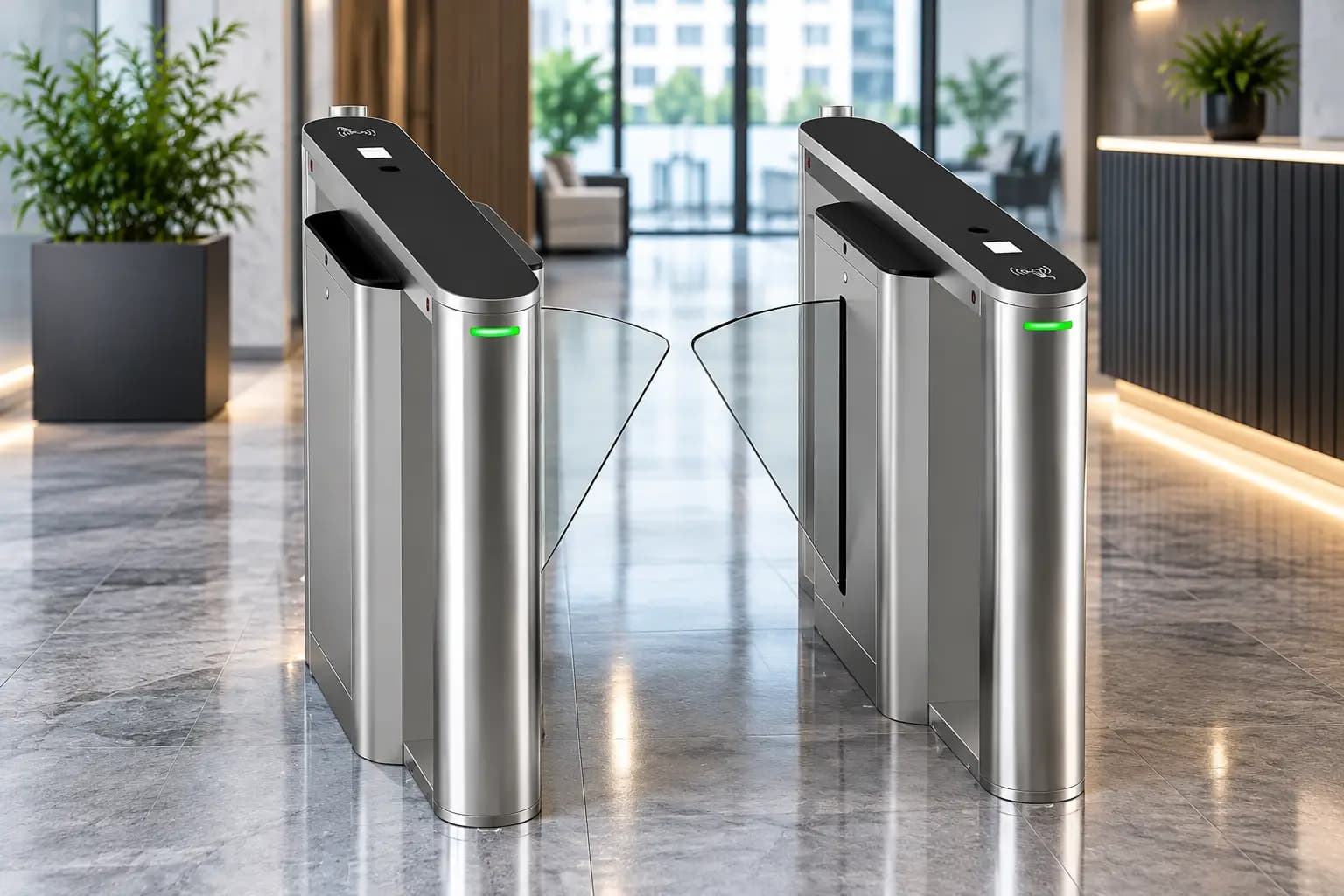
How Does a Flap Barrier Gate Work?
What Is a Flap Barrier Gate?
In its taller glass-clad form, used in reception halls and headquarters lobbies, the same device is normally called a speed gate. The mechanism is identical. What changes is the build and the room it is designed for.
Flap barriers sit in the same family as the swing barrier and the tripod turnstile, and the difference between them is purely mechanical. A swing barrier rotates a solid panel about a vertical axis; a tripod rotates three arms about a hub; a flap barrier retracts its flaps sideways. That one distinction is what decides cycle time, lane width, throughput and, ultimately, which of the three belongs at a given entrance.
One framing point should be made before anything else. A flap barrier is an access management and detection device, not a physical restraint, and its flaps are deliberately light. What it delivers is a controlled, auditable decision point: nothing passes until the system has established that it may, every passage is recorded, and anything irregular raises an alarm that someone is expected to act on.
How Does a Flap Barrier Gate Work?
A flap barrier gate works in five stages. A person presents a credential: a card, a fingerprint, a face, a QR code on a phone. The controller validates it against the permitted list. On a valid result the drive motor retracts the flaps horizontally into the pedestal housings, clearing the lane. The infrared sensor array tracks the person through the lane, reading direction and counting bodies. Once passage is complete the flaps extend back across the lane and the event is written to the access control log.
Present, validate, retract, track, close and log. Everything below is detail sitting beneath those six words, including the part most relevant on a Saudi site, which is what happens to the infrared array when the air outside the door is carrying dust.
Main Components of a Flap Barrier Gate
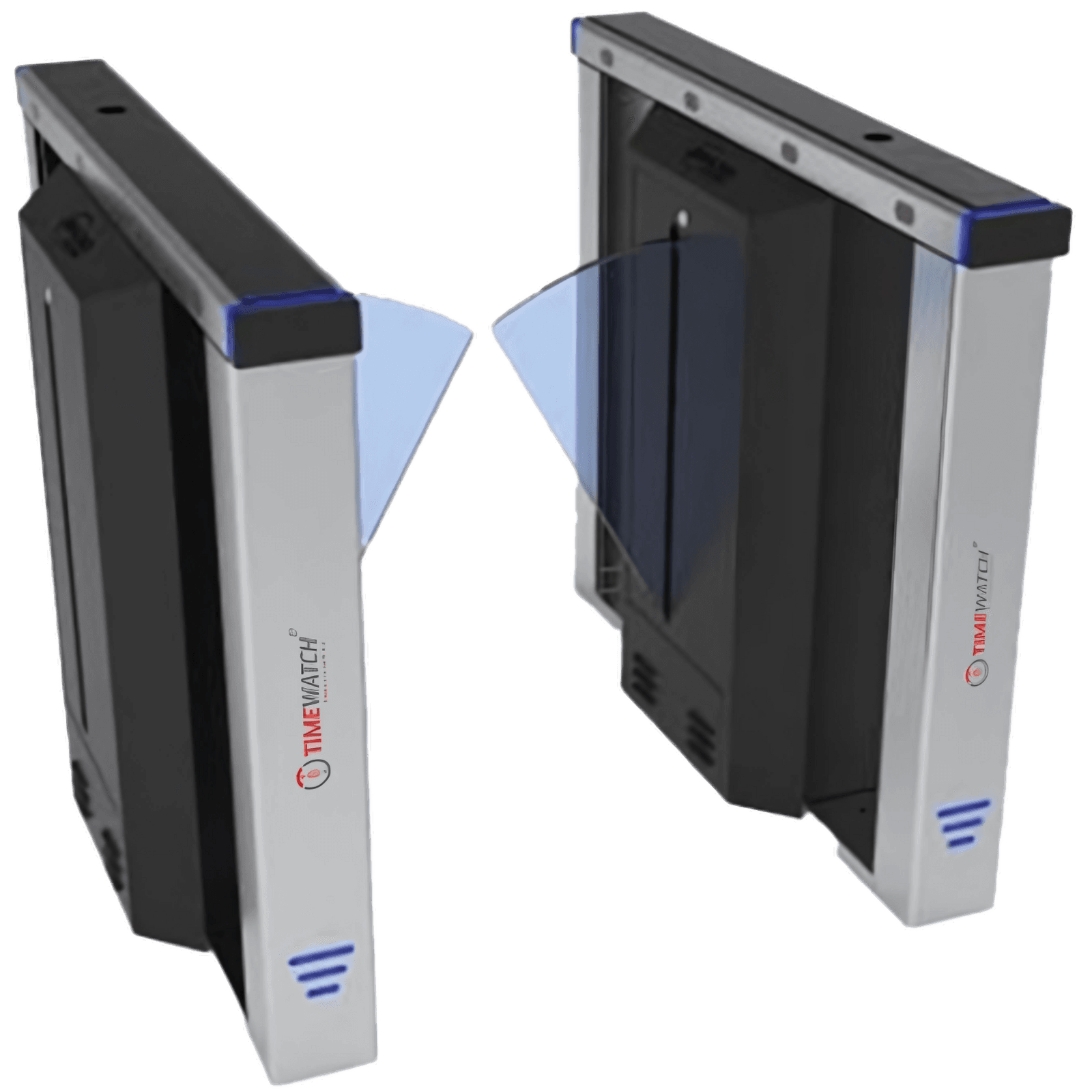
| Component | Function |
|---|---|
| Pedestal housings | Stainless steel cabinets either side of the lane carrying the drive assembly, controller, sensor array and the withdrawn flaps. Usually 304 or 316 grade; 316 is the sensible baseline at Red Sea and Gulf coastal entrances. |
| Retractable flaps | The moving panels that close the lane. Acrylic or polycarbonate in most models, tempered glass in some speed gates. They withdraw into slots in the pedestals rather than rotating open. |
| Retraction slot | The opening in each pedestal face through which the flap enters and leaves the housing, with its guide and seal. A low-profile mechanical detail that becomes a scheduled maintenance item in dusty conditions. |
| Drive motor and mechanism | A servo or brushless DC motor with a linkage, rack or belt converting rotation into horizontal flap travel. Low flap mass means low inertia, which is what allows the short cycle. |
| Controller / control board | The logic of the lane. Takes reader and sensor inputs, drives the motor, applies the anti-tailgating and direction rules, raises alarms and talks to the access control platform. |
| Infrared sensor array | Transmitter and receiver beam pairs at varying heights down the facing sides of both pedestals. The pattern and sequence of broken beams is what the controller reads to establish presence, direction and body count. |
| Credential reader | RFID card reader, fingerprint or palm sensor, face recognition terminal, QR scanner, or a combination. Mounted on the pedestal top or flush into its face. |
| Direction indicators | LED arrows or cross symbols on the pedestal tops showing whether the lane is open in a given direction, and in which direction. |
| Alarm | Audible and visual indication on tailgating, wrong-way entry, forced passage or an unauthorised attempt, normally raised as an event in the software at the same time. |
| Power supply and backup | Low-voltage DC supply inside the pedestal, with battery or UPS backup where the lane must stay under control through an interruption. |
| Manual release | A mechanism freeing the flaps so the lane can be opened by hand during a power failure or for maintenance access. |
Pedestal housings and the retraction slot
The pedestal is a functional part of the mechanism rather than a cover. Its internal width governs how far the flaps can withdraw and therefore the clear lane width, and its facing surface carries the sensor array, so alignment relative to the opposite pedestal is a performance requirement. Two pedestals set slightly out of parallel produce intermittent sensor faults that are commonly misdiagnosed as a control board problem.
The retraction slot deserves a line of its own on a Saudi specification. It is the one opening in the pedestal that cannot be fully sealed, because the flap has to pass through it on every cycle. Where it matters most is covered in the dust section below.
Drive motor and the retraction mechanism
Current models use a brushless DC or servo motor with encoder feedback rather than a simple geared motor. The encoder reports flap position continuously through travel, which supports precise stopping, soft start and soft stop so the flaps do not snap open, and obstruction detection by comparing expected position against actual. Cycle timing, holding force and reversal sensitivity are configurable on most controllers and differ between models.
Flap materials and why they are chosen
Flaps are usually acrylic or polycarbonate, and the choice is deliberate on two counts. Mass first: a light panel has low inertia, so it can be accelerated and stopped quickly, which is the whole basis of the short cycle. Behaviour on contact second: a light panel with rounded edges yields rather than injures if it meets a person, which matters in a device closing across a route used by children, older visitors and anyone carrying something.
Polycarbonate is the tougher of the two under impact; acrylic resists scratching better and holds optical clarity. In an entrance where fine airborne grit is present, scratch behaviour is not a cosmetic footnote, it decides how the lane looks after two years. Some speed gates use tempered glass flaps for appearance; glass is heavier and changes the drive requirement, so it is a model-level design decision rather than a field substitution.
Controller and credential reader
The controller holds the open timers, the direction rules, the response to each sensor pattern, the alarm logic and the interface to the wider system. The reader is deliberately separate from it, so a lane can be re-fitted from card to face recognition, or made to accept both, without touching the barrier mechanism, the reader simply supplies a validated identity to the same controller input.
Infrared sensor array
This is the component that makes a flap barrier more than a powered gate, and it is also the component the local environment attacks hardest. It is covered in full in the next section, and again in the dust section.
How Does a Flap Barrier Gate Work Step by Step?
| Step | What happens | How it works |
|---|---|---|
| 1 | Person approaches the lane | The entry-side beams of the infrared array register someone at the mouth of the lane, and the direction indicator confirms whether the lane is open that way. |
| 2 | Credential is presented | An RFID card is tapped, a finger or palm is placed, a face is presented to the terminal, or a QR code is held to the scanner. |
| 3 | Credential is validated | The reader passes the identity to the controller or access control platform, which checks it against the permitted list together with any time zone, direction or anti-passback rule. A valid match produces an open command; an invalid one is logged as a denied attempt. |
| 4 | Drive motor retracts the flaps | The controller energises the motor, which draws both flaps horizontally through the retraction slots and into the pedestal housings, clearing the lane. This sideways withdrawal is the mechanical difference from a swing barrier, whose panels rotate about a vertical axis. |
| 5 | Open position is confirmed | The encoder or a limit position tells the controller the flaps are fully withdrawn and the motor stops. |
| 6 | Person walks through | The infrared beam pairs break and restore in sequence as the body moves down the lane. The controller reads that sequence continuously rather than sampling it. |
| 7 | Passage is analysed | From which beams broke, at what heights and in what order, the controller establishes direction, counts the bodies in the lane and decides whether this is one authorised passage or a violation. |
| 8 | Passage is confirmed complete | When the exit-side beams clear and no further body is detected, the controller treats the passage as finished. |
| 9 | Flaps extend back across the lane | The motor drives the flaps out of the pedestals until they meet at the lane centre, ready for the next credential. |
| 10 | Event is logged | The passage (identity, direction, lane, timestamp and any alarm) is written to the access control or attendance database. |
If a second person is detected in the lane without a second authorisation, or if someone enters against the configured direction, step 9 does not run normally. The controller closes the flaps and raises an alarm instead. Note also that steps 1, 6, 7 and 8 all depend entirely on the infrared array reading cleanly, which is the thread the dust section picks up.
How the Infrared Array Counts Bodies and Detects Tailgating
The array is the core of the anti-tailgating logic and the single component that most separates a capable lane from a basic one. Down the facing side of each pedestal sits a column of infrared emitters with matching receivers opposite, each pair forming a beam across the lane at a set height. A lane may carry anywhere from a handful of pairs to well over twenty depending on the model. No single beam is clever; what the controller does with the whole pattern is.
As a person walks through, their body interrupts beams in a characteristic order (entry-side first, then middle, then exit-side) and beams at torso height stay broken longer than those at head or knee height. From that pattern the controller derives direction of travel, body count, and anomalies such as a low break with nothing above it, which is usually a bag or a trolley rather than a person. On a violation the flaps close, the alarm sounds, and the event is written to the software with its own classification so it can be matched against camera footage afterwards.
Sensor array quality decides anti-tailgating quality. A lane with too few beam pairs, or with all of them clustered at one height, cannot resolve a second person following closely behind the first, the two bodies read as a single continuous interruption and nothing is flagged at all. Where anti-tailgating is a genuine requirement at a ministry or headquarters entrance rather than a line in a specification, the number of beam pairs and their height distribution deserves as much scrutiny as the pedestal finish.
Throughput and the Morning Peak at a Saudi Entrance
Throughput is the reason flap barriers are chosen, and it is also where entrances most often go wrong. Figures commonly quoted for a flap barrier lane sit in the region of 30 to 40 people per minute, but that is approximate and equipment-dependent, it varies with the model, the drive, the controller timing and how the lane is configured.
More importantly, it assumes something that a real entrance rarely delivers. Quoted throughput figures assume people present credentials smoothly and continuously. A headquarters building in Riyadh or a ministry entrance in the Eastern Province does not work that way at eight in the morning. The limiting factor is almost never how fast the flaps move; it is how long someone takes to find a card at the bottom of a bag, position a finger correctly on the sensor, or stop and square up to a face terminal. A lane whose mechanism supports forty passages a minute will deliver a fraction of that if each person needs three seconds to produce a credential.
This matters more here than in many markets because of how Saudi arrival patterns are shaped. A large office or ministry building does not receive its staff evenly across the morning; it receives most of them inside a compressed window, and a university receives a far sharper surge at every class change than its daily headcount suggests. Averaging arrivals across the day produces a lane count that is comfortably wrong.
The design consequence is straightforward. Size the lane count from arrivals observed at the real peak at the real entrance, not from headcount divided by a catalogue rate, and treat credential presentation time as the governing variable. Where presentation time is the constraint, hands-free identification at the lane (a face recognition terminal rather than a card tap) recovers more throughput than a faster mechanism ever will.
How Dust and Heat Affect a Flap Barrier Lane in the Kingdom
The mechanism described above does not change in Saudi Arabia. What changes is the environment the sensors and the moving parts have to work in, and for this particular device the dominant issue is not heat (most lanes sit inside a conditioned lobby) but airborne particulate reaching an optical sensor array and a mechanical slot.
Dust on the infrared emitter and receiver windows
The array works by a receiver confirming that it can see its paired emitter. A film of fine dust on either window attenuates the beam. Attenuate it enough and the receiver reports the beam as broken with nobody in the lane, so the controller believes a body is present, refuses to close the flaps, holds the lane open, or raises a tailgating alarm against a passage that was perfectly legitimate.
This is the single most common nuisance fault on flap barrier lanes in the Kingdom, and it is almost always a cloth problem rather than an electronics problem. Entrances closest to an external door, to a vehicle drop-off or to active construction accumulate it fastest, and the symptom pattern is distinctive: alarms rising gradually over weeks, worse at the busiest lane, and clearing completely after the windows are wiped. A rise in tailgating alarms at one lane is a sensor-cleaning signal far more often than it is a change in user behaviour.
Dust in the retraction slot
This is specific to the flap mechanism and has no equivalent on a swing barrier, because a swing panel never withdraws into the housing. The flap passes in and out through a slot in the pedestal face on every cycle, and that slot cannot be sealed. Fine grit carried in on shoes and on moving air settles along it, and each cycle then drags the flap edge across whatever has collected there.
Two consequences follow. The flap surface picks up fine scoring along the line where it enters the slot, which is visible on a clear acrylic panel long before it affects function. And the guide loads up, which raises drive resistance, and because the controller reads motor load as an obstruction signal, enough accumulation will produce reversals on a lane with nothing in it. Clearing the slot and its guide should be a named line on the service sheet for Saudi installations, not an item folded into general cleaning.
Heat at the exposed entrance rather than the conditioned lobby
Summer ambient across much of the Kingdom sits above 45 °C and inland sites approach or pass 50 °C. Most flap barrier lanes live inside the air-conditioned envelope and never see that, which is why heat derating matters less for this device than for outdoor equipment. The exceptions are real, though: covered but unconditioned entrance halls, stadium and exhibition concourses, campus gatehouses and transport platforms. On those, the enclosure temperature around the drive and controller should be treated as a genuine specification question and confirmed against the manufacturer's stated operating range rather than assumed from an indoor installation.
Direct sun on the array is the other heat-adjacent issue, and it is an optical one rather than a thermal one. Strong sunlight is a powerful infrared source, and a lane set behind a large glazed façade can receive it directly along the beam path at particular times of day. Modulated sensors are designed to reject ambient infrared, but the tolerance differs by model, so a lane facing a curtain wall is a case to raise with the manufacturer at design stage rather than discover at commissioning.
Coastal air at Red Sea and Gulf entrances
At Jeddah and Yanbu on the Red Sea, and at Jubail, Dammam and Al Khobar on the Gulf, humid salt-laden air reaches the entrance every time the doors open. Salt is hygroscopic, it draws moisture from humid air and holds a conductive film against metal long after any visible wetting has gone. On a flap barrier that film attacks the pedestal fixings, the base frame where it meets the floor, exposed fasteners and cut edges, and the cable terminations inside the pedestal base.
The specification responses are 316 grade stainless for the pedestal shell rather than 304, stainless fasteners of a matching grade with attention to avoiding dissimilar-metal contact, sealed cable entries at the pedestal base, and a floor detail that drains rather than allowing wash-down water to stand against the base. A conformally coated control board resists this environment considerably better than an uncoated one, and on a coastal installation that is a reasonable thing to ask about during technical evaluation.
Setting cleaning intervals from the entrance, not the calendar
A fixed number of service visits a year fits this device poorly, because the two variables that actually drive attention (passage count and particulate exposure) vary enormously between entrances in the same building.
| Entrance condition | Dominant stress | Attention pattern typically suited to it |
|---|---|---|
| Headquarters or ministry lobby, high morning peak, conditioned, set back from the external door | Cycle count, fingerprints and settled dust on the array | Array window cleaning at a short interval regardless of the mechanical service, since this is where nuisance alarms originate. Mechanical servicing on the standard interval. |
| Entrance opening directly to the outside, vehicle drop-off or open forecourt | Airborne dust reaching both the array and the retraction slot | Short intervals on array windows and slot clearing, treated as separate named tasks. Flap inspection for edge scoring at every visit. |
| Coastal entrance at a Red Sea or Gulf location | Salt-laden humidity in addition to dust | Corrosion inspection of pedestal fixings, base frame and cable terminations at every visit, with early attention to any coating or finish damage before it spreads. |
| University or campus lane with concentrated class-change surges | Very high cycle count in short bursts, long quiet periods | Service scheduled around the academic calendar rather than evenly, with a full exercise of the lane, the safety response and the manual release before each term begins. |
| Entrance adjacent to active construction or fit-out works | Very high particulate load, temporary | Temporary short-interval cleaning for the duration of the works, reverting afterwards. Common where a building is occupied in phases. |
After any significant dust event, an additional inspection is justified whatever the schedule says. Array windows, the retraction slots and the flap edges are the three items to check first, and all three take minutes.
How Flap Barrier Safety Systems Work
Because the flaps move across a space people occupy, protection is layered, and each layer works differently.
- Presence interlock: while the array detects a body in the lane the controller is inhibited from closing. This prevents the close command rather than interrupting one.
- Obstruction detection: the controller monitors motor load or encoder feedback. A rise in load, or travel stopping short of the expected position, is read as contact and the flaps reverse. Sensitivity is configurable on most models.
- Yielding flap material: the light acrylic or polycarbonate panel is itself part of the safety design, limiting the force that can be applied to a person.
- Fire alarm interface: a dry contact from the fire panel drives the flaps to retract and hold open, clearing the escape route. On any lane forming part of an egress path this is essential rather than optional.
- Power failure behaviour: lanes on an escape route are normally configured to retract and stay open on loss of supply.
That last pair is a life-safety decision rather than a default setting. Fail-safe means the lane opens on alarm or power loss, prioritising evacuation; fail-secure means it stays closed, prioritising containment. Which applies depends on the route, the building's fire strategy and the applicable requirements, and in the Kingdom that question sits within the framework of the General Directorate of Civil Defense. It must be agreed with the fire consultant and recorded, not set by whoever commissions the lane.
One local note. Because dust-driven false triggers are common on this device, there is a standing temptation on site to turn down obstruction sensitivity or to work around a troublesome sensor pair to stop the nuisance alarms. That converts a cleaning task into a safety problem. The correct response to an array that keeps triggering is to clean it, check alignment and shorten the interval.
Speed Gates and Standard Flap Barriers
The two terms overlap and are used loosely, so it is worth being precise. A speed gate works on exactly the same principle as a standard flap barrier, retracting flaps, infrared array, the same operating sequence. What differs is build and setting: taller glass pedestals instead of short stainless cabinets, a slimmer profile so a bank of lanes takes less floor area, a quieter drive because a reception hall where people are met and greeted cannot tolerate mechanical noise, and finish-led design with integrated lighting and flush readers.
A standard flap barrier is built for utility: robust stainless pedestals, straightforward maintenance access and tolerance of the traffic and dust of a campus gate or a transport concourse. Neither is a better device. They are built for different rooms, and most large Saudi developments end up with both, speed gates in the headquarters reception, standard lanes at the staff and service entrances behind it.
Where Flap Barrier Gates Are Used in Saudi Arabia
Pedestrian entrance control in the Kingdom concentrates around a handful of building types where arrival is compressed into short, predictable windows.
- Corporate headquarters buildings: the dominant application, and the one that drives the specification. Large single-tenant or anchor-tenant buildings in Riyadh, Jeddah and across the Eastern Province receive most of their staff inside a short morning window, which makes lane count at peak the operational question rather than lane count against headcount.
- Ministry and government compounds: controlled, recorded entry with staff and visitor flows separated, visitor passage tied to a formal registration process, and a complete log of who entered which building and when.
- Large mixed-use and retail developments: office cores within retail and leisure schemes, where the entrance control line separates public circulation from tenant floors and has to work visually as part of the lobby design rather than as equipment dropped into it.
- Universities and higher education campuses: buildings in Riyadh, Jeddah, Dhahran, Abha, Tabuk, Makkah and Madinah where class changes produce surges far sharper than any office peak, and where attendance is frequently captured at the lane itself.
- Hospitals and medical cities: separating restricted clinical areas from public circulation while keeping a wide lane permanently clear for beds, trolleys and equipment, which on this device means a wide accessible lane is not optional.
- Industrial and plant administration buildings: office and control-room entrances at facilities in Jubail, Yanbu and the wider Eastern Province, with attendance recorded at the lane and shift-change traffic arriving in a single block.
- Stadiums, exhibition halls and event venues: very high short-duration throughput, usually with QR or ticket validation at the lane and a requirement that every gate can be driven open at once.
- Data centres and controlled facilities: tighter anti-tailgating settings, denser sensor arrays and interlocked lane arrangements where a single authorised passage must be provable.
Across all of these the pattern is the same: the lane is one stage in an entrance that also contains identification, visitor handling, screening and recording, and it performs when it is specified as part of that entrance rather than bought on its own. TimeWatch supplies flap barrier gates, speed gates and associated pedestrian entrance control equipment, and is represented in Saudi Arabia through Shuruq Saudi as authorised national distributor.
Integration With Other Systems
A flap barrier lane rarely operates alone. The usual integrations:
- Access control: the credential database governing doors and vehicle gates also governs the lane, so one revocation closes every route at once.
- Time and attendance: the passage event doubles as the attendance punch, removing a separate clocking step at shift change and at class change.
- Visitor management: a pre-registered visitor receives a QR code or temporary card the lane accepts for a defined window, with arrival notified to the host. On ministry and headquarters sites, where visitor processes are formal, this is normally the point the whole process is built around.
- Face recognition terminals: hands-free presentation, which attacks the actual throughput constraint rather than the mechanical one.
- CCTV and video analytics: footage bookmarked against each lane event, so a tailgating alarm can be reviewed directly from its log entry. This is what converts an alarm into evidence, and without it the alarm achieves little.
- Fire alarm systems: automatic retract-and-hold on alarm wherever the lane forms part of an escape route.
- Occupancy and muster reporting: because the array counts bodies rather than credentials, the lane supports a reasonably accurate live occupancy figure, which matters on sites that have to account for everyone during an evacuation.
Installation and Lane Layout for Saudi Entrances
Most flap barrier complaints trace to layout rather than equipment. The principal considerations, with the local factors called out:
- Floor flatness and pedestal alignment: the pedestals must be level and truly parallel, or opposing sensor pairs fall out of alignment and produce intermittent faults that look exactly like a board failure.
- Lane width and the accessible lane: a standard flap lane will not take a wheelchair, a luggage trolley or a hospital bed, so an entrance built entirely from standard lanes has a problem it cannot solve later. Pair the standard lanes with at least one wide accessible lane and settle it at design stage, not at handover.
- Queueing and circulation depth: approach space in front of the lanes sized for the morning peak rather than for average flow, and clear space behind so people who have passed are not held up by those waiting at the lifts.
- Distance from the external door: every metre between the entrance doors and the lane bank reduces the dust reaching the array. Where the layout allows it, this is the simplest reliability improvement available and it is almost always decided by accident.
- Reader position: set at a height and angle people find without being told. A badly placed reader adds a second to every passage, and a second per passage is the whole difference at peak.
- Lighting and glazing: direct sun along the beam path affects some models, so check the manufacturer's guidance for lanes near a curtain wall or an atrium.
- Cable routing: power, network and reader cabling up through the floor into the pedestal base, in conduit laid before the floor finish, with sealed entries at coastal sites.
- Power supply and backup: stable supply with UPS where lane control must survive an interruption.
- Fire interface wiring: the dry contact from the fire panel must be pulled and tested during installation, not added afterwards.
Maintenance Considerations
Flap barriers are electromechanical devices cycling continuously in a public space. In this climate several items need attention more often than a generic schedule suggests:
- Clean the emitter and receiver windows on both pedestals. On Saudi entrances this is the highest-value routine task on the list, because it removes the most common source of nuisance alarms.
- Clear the retraction slots and their guides, and treat this as its own named task rather than part of general cleaning.
- Inspect the flaps for edge scoring at the slot line, for cracks and for damage, and confirm they still meet cleanly at the lane centre.
- Check pedestal alignment, particularly after floor work or an impact from a trolley.
- Verify the drive runs smoothly through full travel with no binding at either end.
- Test obstruction reversal deliberately with a soft object, at the configured sensitivity, and record the setting so nobody quietly reduces it.
- Test the fire alarm interface during scheduled drills and confirm the lane behaves exactly as the fire strategy requires.
- Confirm the manual release operates, before it is needed rather than during an incident.
- Inspect pedestal fixings, base frames and cable terminations for corrosion at coastal entrances, and clean accumulated salt between visits.
- Review alarm logs by lane. A gradual rise at one lane points to a sensor or layout problem long before anyone reports a fault.
Regulatory and Standards Context in Saudi Arabia
Security and life-safety installations in the Kingdom sit within the framework administered by the General Directorate of Civil Defense, which is the authority concerned with fire and life-safety arrangements on occupied premises. For a flap barrier that engagement is specific and narrow: it is about how the lane behaves when the fire alarm sounds, whether the flaps retract and hold open, how the lane is treated in the building's escape route capacity, and whether the dry contact from the fire panel actually does what the strategy says it does.
On the equipment side, specifications in the Kingdom commonly reference standards published by SASO (the Saudi Standards, Metrology and Quality Organization) and by GSO (the GCC Standardization Organization), along with the conformity and product-registration arrangements SASO administers for goods placed on the Saudi market. Government bodies, large developers and institutional clients also publish their own technical specifications, which frequently go beyond the general framework.
Two points should be stated plainly. Nothing on this page should be read as a statement that any particular product is approved, certified or compliant under any of these frameworks: this section is context, not a claim, and conformity status is a property of a specific model and a specific supply, evidenced by documentation for that supply. And current requirements must be confirmed with the relevant authority for the specific project, because they change over time and vary by building type. The position that applies to a hospital, a ministry building, a university and a stadium is not the same position.
Benefits and Limitations
Benefits
- Short cycle and high lane throughput compared with rotating-arm devices, because the flaps retract rather than sweep through an arc.
- Anti-tailgating and direction detection through the infrared array, with each violation logged and alarmed as its own event type.
- A complete audit trail by identity, direction and time, usable for attendance and for live occupancy reporting.
- Reader-agnostic: card, fingerprint, face or QR, interchangeable without altering the mechanism.
- In speed gate form, an entrance control device that suits a designed reception rather than fighting it.
Limitations and considerations
- A flap barrier controls passage; it does not physically restrain. The flaps are light by design and a determined person can force or vault them. The security value comes from the barrier, the alarm, the CCTV bookmark and a defined response procedure working together, the device on its own is not the control.
- Lane width is a hard constraint. Standard lanes do not take wheelchairs, trolleys, beds or large luggage, so a wide accessible lane is normally required alongside.
- Anti-tailgating performance varies widely with array density and height distribution. Too few beams and a close follower is not detected at all.
- Quoted throughput is not achieved throughput. Credential presentation speed, not flap speed, sets the real rate at every entrance.
- Dust demands more attention here than the datasheet implies. Array windows and retraction slots are scheduled tasks in this environment, and reliability depends on them being treated as such.
- Flap surfaces show wear in heavy use, and fine grit at the slot line accelerates it. Replacement panels should be planned for rather than treated as a failure.
Exact behaviour (cycle time, sensor count, obstruction sensitivity, operating temperature range, fail-state configuration and integration options) depends on the specific model, controller, firmware and site configuration, and should always be confirmed against the datasheet for the equipment actually being specified.
Flap Barrier vs Swing Barrier vs Tripod Turnstile
| Flap barrier | Swing barrier | Tripod turnstile | |
|---|---|---|---|
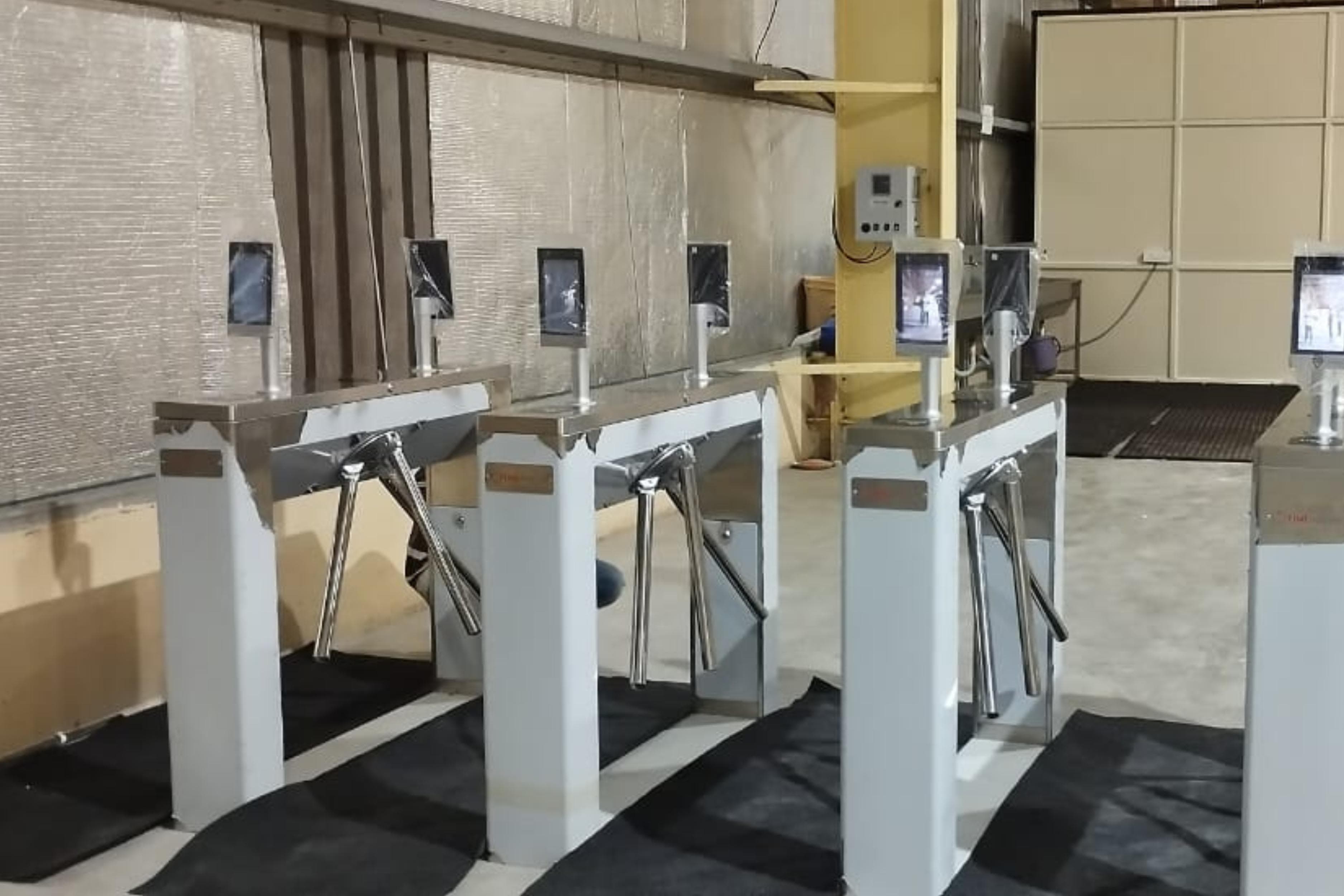
| Mechanism | Flaps withdraw horizontally into the pedestals through a retraction slot | Solid panels rotate open about a vertical axis | Three horizontal arms rotate about a hub; the user pushes through one segment |
| Cycle and throughput | Short cycle; commonly quoted around 30 to 40 people per minute per lane, equipment-dependent | Longer cycle, because the panel must sweep an arc before the lane is clear | Slowest; each person physically rotates the arms one segment at a time |
| Accessibility | Standard lanes are narrow; a wide accessible lane is normally added alongside | Wide-panel versions frequently serve as the accessible lane in a bank of gates | Not accessible; a separate gate is required for wheelchairs and trolleys |
| Dust exposure points | Array windows plus the retraction slot the flap passes through on every cycle | Array windows and the pivot assembly; no retraction slot | Mechanical hub and bearings; fewer optical dependencies |
| Typically suited to | Headquarters and ministry lobbies, mixed-use developments, campus buildings, high-peak entrances | Receptions needing a wider lane, mixed pedestrian and trolley traffic | Plant gates, stadium concourses and other rough-duty high-volume entries |
The three are not better and worse versions of one another. A flap barrier is chosen for throughput and for how it reads in a lobby, a swing barrier for lane width and mixed traffic, a tripod turnstile for durability where conditions are hard. Large Saudi entrances routinely use two of the three on the same frontage.
Frequently Asked Questions
How does a flap barrier gate open and close?
On a valid credential the controller commands the drive motor, which draws both flaps horizontally through slots in the pedestal faces and into the housings, leaving the lane clear. The flaps withdraw sideways rather than swinging through an arc, which is what keeps the cycle short. When the infrared array confirms the person has passed, the motor drives the flaps back out until they meet at the lane centre.
What is the difference between a flap barrier and a swing barrier?
Mechanically, the flap barrier withdraws its flaps sideways into the pedestals while the swing barrier rotates solid panels about a vertical axis. That single difference drives the rest: retraction clears the lane faster, so flap barriers suit entrances where peak throughput is the problem, while swing barriers are available in wider lane formats better suited to trolleys, luggage and wheelchair passage.
How many people per minute can a flap barrier lane really handle in practice?
Catalogue figures sit around 30 to 40 people per minute per lane, but they assume credentials are presented smoothly and continuously. Real entrances are limited by how long each person takes to find a card or square up to a face reader, not by flap speed. Lane count should be derived from arrivals observed at the actual morning peak rather than from headcount divided by a published rate.
Why does a flap barrier raise tailgating alarms when nobody has tailgated?
Almost always because dust has settled on the infrared emitter or receiver windows. A dust film attenuates the beam until the receiver reports it as broken, so the controller behaves as though a body is in the lane and flags a violation. The pattern is distinctive: alarms rise gradually over weeks and clear completely once the windows are wiped. It is a cleaning interval problem, not an electronics fault.
Does dust get into the slot the flaps retract into?
Yes, and it is specific to this mechanism because a swing barrier panel never withdraws into the housing. Grit settles along the slot, the flap edge drags across it on every cycle, and two things follow: fine scoring along the flap at the slot line, and rising drive resistance. Since the controller reads motor load as an obstruction signal, enough accumulation produces reversals on an empty lane.
What are flap barrier flaps made of?
Acrylic or polycarbonate in most models, with tempered glass in some speed gates. Both plastics are light, which keeps inertia low so the flaps accelerate and stop quickly, and both yield rather than injure on contact. Polycarbonate withstands impact better; acrylic resists scratching and holds clarity, which matters where fine airborne grit reaches the lane.
Can a flap barrier stop someone who is determined to get through?
No. A flap barrier controls passage but does not physically restrain. The flaps are deliberately light so they yield on contact, and a determined person can force or vault them. Its security value comes from the barrier, the alarm it raises, the CCTV footage bookmarked against that event, and a response procedure someone actually follows. The device alone is not the control.
Are flap barrier lanes wide enough for a wheelchair, a trolley or a hospital bed?
Standard lanes are not. They are deliberately narrow, which is part of how the array resolves a single body, and they will not take a wheelchair, a luggage trolley or a bed. Entrances therefore pair several standard lanes with at least one wide accessible lane. This has to be settled at design stage, because adding a wide lane to a completed bank means rebuilding the entrance.
What happens to a flap barrier during a fire alarm or a power failure?
Where the lane sits on an escape route it is normally configured to retract the flaps and hold them open on fire alarm or loss of power, driven by a dry contact from the fire panel. Whether a given lane is fail-safe or fail-secure is a life-safety decision rather than a setting, agreed with the fire consultant, recorded, and considered within the framework of the General Directorate of Civil Defense.
Which authorities and standards apply to entrance control equipment in Saudi Arabia?
Fire and life-safety arrangements on occupied premises, including how a lane behaves on alarm, fall within the framework of the General Directorate of Civil Defense. Equipment specifications commonly reference SASO, the Saudi Standards, Metrology and Quality Organization, and GSO, the GCC Standardization Organization. Large clients add their own specifications on top. Requirements change and vary by building type, so the current position must be confirmed with the relevant authority for the specific project.
How often should a flap barrier lane be serviced in Saudi conditions?
Intervals should follow passage count and particulate exposure rather than a fixed calendar. Array window cleaning and retraction slot clearing belong on a shorter interval than the mechanical service, and both should be named tasks. Coastal entrances at Jeddah, Yanbu, Jubail and Dammam add corrosion inspection of pedestal fixings and cable terminations at every visit. Campus lanes are better serviced around the academic calendar than evenly.
