

How Does a Tripod Turnstile Work?
What Is a Tripod Turnstile?
A tripod turnstile (also called a tripod barrier, tripod gate or waist-height turnstile) is the lane type you find where a workforce arrives in bulk and every passage has to be counted. In the Kingdom that means the plant and contractor gates of the industrial cities at Jubail and Yanbu, the construction compounds of the developments now rising across Riyadh and the Red Sea coast, the port and logistics perimeters at Jeddah and Dammam, and the entry lines of stadiums and large venues.
It belongs to the same family as the flap barrier and the swing barrier, but it solves the one-person-per-credential problem in a fundamentally different way, and that difference is the reason it keeps being specified long after it stopped being the obvious choice for a finished lobby.
The rotor head sits at an angle rather than horizontally, so the arms are at a comfortable pushing height on the approach side and sweep upward and away as the user walks through. That angle is what lets a single 120-degree turn clear the lane for one body and bring the next arm into the blocking position behind them.
How Does a Tripod Turnstile Work?
A tripod turnstile works in five stages. A person presents a credential at the reader, a card, a fingerprint, a face, a QR code. The controller validates it and, on a valid result, releases the lock by energising a solenoid or electromagnet that withdraws a locking pin from the cam plate on the rotor shaft. The user then pushes the arm and the rotor turns through 120 degrees, its speed governed by a damper. A microswitch or encoder confirms the completed rotation, the lock re-engages against the next cam position, and the passage is logged.
Present, validate, release, rotate, re-lock. Everything else on this page is detail beneath those five words, including the environmental engineering that decides how many of those cycles the mechanism will deliver before it needs attention.
Main Components of a Tripod Turnstile
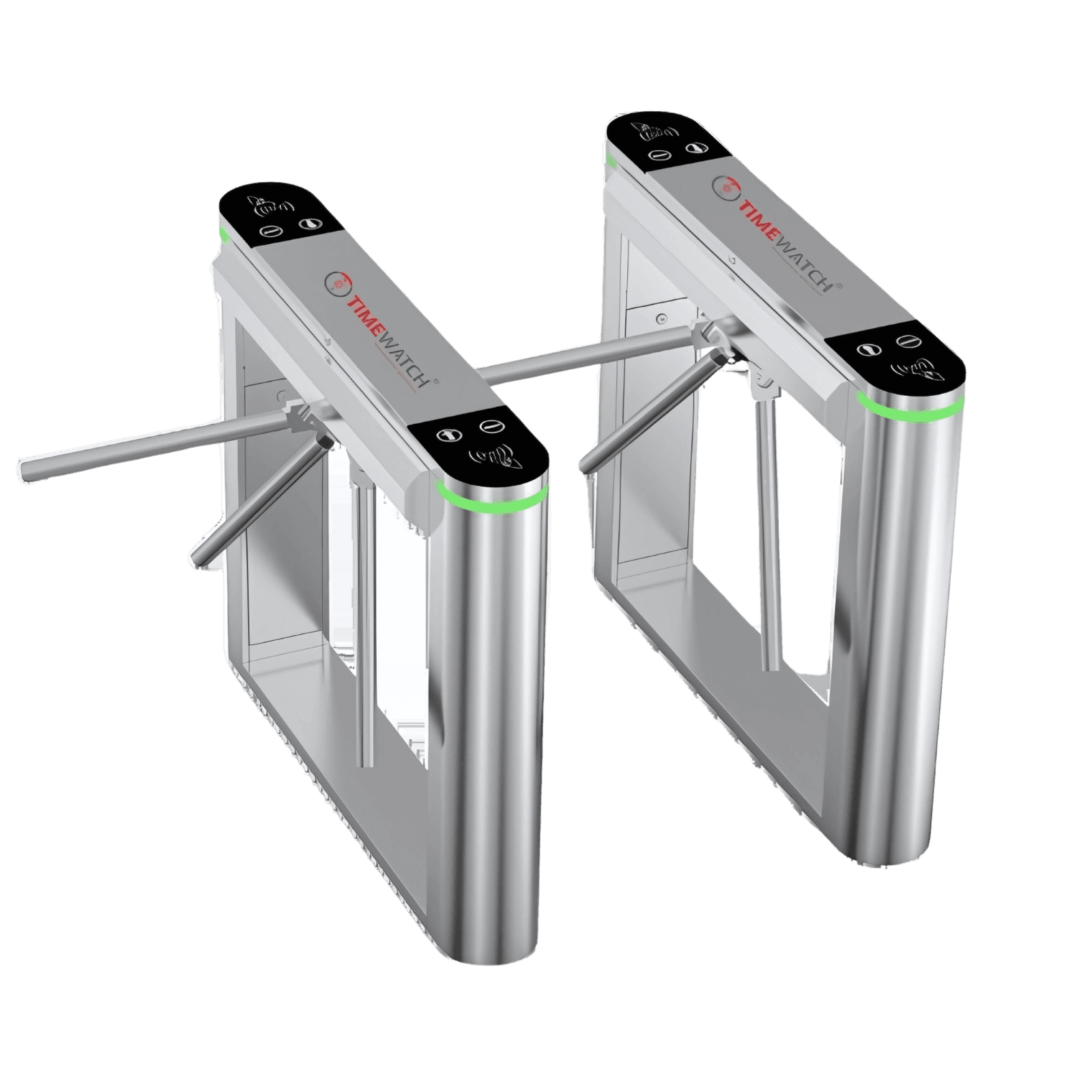
| Component | Function | What the Saudi environment adds to the specification |
|---|---|---|
| Housing / pedestal | Stainless steel cabinet carrying the rotor, lock, damper, controller and power supply. | 304 grade is the common baseline; 316 is worth the conversation at coastal and humid sites. Sealing at cable entries and lid joints matters more here than the catalogue assumes. |
| Rotor head and three arms | Three horizontal arms 120 degrees apart on a hub, the shaft angled so the arms sweep up and away as the user passes. | Arm finish takes abrasion from wind-borne particles and from gloved hands at a site gate. Individually replaceable arms are a practical requirement, not a refinement. |
| Locking mechanism | A solenoid or electromagnet driving a locking pin, plus a cam plate keyed to the rotor shaft. The pin sits in a notch to hold the rotor. | Fine particulate reaching the pin and notch is the mechanism's main contamination path. Enclosure sealing around the lock assembly is the design detail to interrogate. |
| Damper | A hydraulic or friction unit on the rotor shaft governing rotation speed, so the arms cannot be spun violently and come to a controlled stop. | The wear part, and the one this climate attacks hardest. Hydraulic units also change characteristic with temperature, which shows up as a different feel between a July afternoon and a January morning. |
| Controller / control board | Drives the solenoid per direction, applies direction and anti-passback rules, manages the release timeout and talks to the access control platform. | Internal cabinet temperature on a gate in direct sun runs well above ambient. Ventilation, shading and component rating all belong in the specification conversation. |
| Microswitch or rotary encoder | Reads rotor position and confirms a full 120-degree rotation, which triggers the re-lock and the log entry. | Contact-based switches are more exposed to dust ingress than a sealed encoder. Which method a model uses is worth establishing before purchase, not after. |
| Credential reader | RFID card reader, fingerprint or palm sensor, face recognition terminal or QR scanner, normally one per side. | Fingerprint sensors struggle with the dry, dusty hands of a site workforce. Card and face methods are generally steadier on industrial gates for that reason. |
| Direction indicator LEDs | Arrow and cross symbols showing whether the lane is released in a given direction, so users do not push a locked rotor. | Indicator brightness has to be readable in strong direct sunlight at an open gate, which is a different requirement from an indoor lobby. |
| Power supply | Low-voltage DC inside the housing, with battery or UPS backup where the lane must stay controlled through an outage. | Elevated enclosure temperature shortens the life of power supply components, so backup capacity should be checked rather than assumed after a few summers. |
| Drop-arm mechanism (where fitted) | A latch releasing the arms so they fall vertically on fire alarm or loss of power, clearing the lane for evacuation. | A hardware variant that must be ordered, not a setting. Its latch is also a dust-sensitive mechanism and needs testing on a defined cycle. |
Housing and pedestal
The housing absorbs every push, so its fixing matters more than it looks. A tripod on an uneven or under-anchored base rocks very slightly under each passage, and that movement works into the rotor bearing and the lock alignment over a few hundred thousand cycles. On an industrial gate passing a full shift twice a day, a few hundred thousand cycles is not a long period.
Floor condition on Saudi sites deserves its own thought. A turnstile line installed on a temporary slab during construction, or on a surface that has since been resurfaced around it, frequently ends up with one pedestal carrying a disproportionate share of the load. Re-checking anchor torque after the first few months of service catches this while it is still an adjustment rather than a bearing replacement.
Rotor head and the three arms
Three arms at 120 degrees is the smallest number that keeps one arm blocking the lane while another is clear of the walking path. Two arms would need a 180-degree turn, sweeping the trailing arm through the user's path; four would leave a gap too narrow to walk through. Arms are usually stainless steel tube and, on most models, individually replaceable after an impact, which matters at a site gate, where arms meet tool bags, scaffold poles and the occasional reversing vehicle.
Locking mechanism: solenoid, cam plate and locking pin
This is the heart of the device. Keyed to the rotor shaft is a cam plate carrying three notches, one per arm position. A spring-loaded pin rests in whichever notch is presented, and while it is seated the rotor cannot turn. When access is granted, a solenoid or electromagnet pulls the pin clear. The rotor is now free, but only free, nothing drives it, and the user supplies the force.
As the rotor turns, the pin rides the plate's outer profile under spring pressure until, at 120 degrees, the next notch arrives beneath it and the pin drops in. That sequence completes mechanically whatever the electronics do next, which is what makes a tripod dependable on a gate where the network link, the reader and the power supply are all having a harder time than they would indoors.
The damper
The damper resists rotation in a controlled way. Without it a released rotor could be spun hard, the arms would whip round and the pin would slam into the next notch. With it, the arms move at a steady pace whatever force is applied and stop softly as the lock re-engages.
It is also the component that wears, and on Saudi sites it wears for a reason that is specific to this environment rather than general. Fine abrasive particulate reaching a damper's seals degrades them, hydraulic fluid loses its characteristic at sustained high temperature, and a friction unit's surfaces pick up contamination that changes their behaviour. A tripod that has started to feel loose, notchy, or that slams audibly at the end of each rotation is almost always reporting its damper, not its lock. Solenoids and control boards are replaced chasing that symptom far more often than they should be, and the lane comes back with the same complaint a few weeks later.
Controller, reader and rotation sensing
The controller holds the release timeout (how long the rotor stays unlocked before the permission lapses) along with the direction rules, the anti-passback logic and the interface to the wider system. The reader is separate from the mechanism, so a lane can be re-fitted from card to face recognition without touching the rotor.
Rotation is sensed by microswitches tripped by lobes on the cam plate, or on newer models by a rotary encoder reading the shaft continuously. An encoder can tell a completed passage from a turn abandoned halfway. Which method a lane uses, and how it treats a partial rotation, varies by model and should be confirmed against the datasheet, particularly on a site where the headcount the lane produces will be used for muster reporting.
How Does a Tripod Turnstile Work Step by Step?
| Step | What happens | How it works |
|---|---|---|
| 1 | Lane sits locked at rest | The pin is seated in a cam plate notch, holding the rotor. One arm blocks the lane at waist height and the indicator shows a cross. |
| 2 | Credential is presented | An RFID card is tapped, a finger or palm placed, a face presented, or a QR code shown to the scanner. |
| 3 | Credential is validated | The controller or access control platform checks the identity against the permitted list, with any time zone, direction or anti-passback rule applied. An invalid one is logged as a denied attempt. |
| 4 | Lock is released | The controller energises the solenoid for that direction, withdrawing the pin from the notch. The rotor is free and the indicator changes to an arrow. |
| 5 | User pushes the arm | On mechanical and semi-automatic models the user supplies the force. On a fully automatic model a motor drives the rotation instead. |
| 6 | Rotor turns under damper control | The damper holds the arms to a steady pace however hard they are pushed, so they cannot be spun onto the next person. |
| 7 | Rotation reaches 120 degrees | The next notch arrives beneath the waiting pin, which drops in. The rotor is locked and the next arm blocks the lane. |
| 8 | Completed rotation is detected | A microswitch tripped by the cam plate, or an encoder on the shaft, confirms a full segment has been travelled. |
| 9 | Permission is consumed | The controller clears the release, so anyone following finds the rotor locked. If rotation is not completed within the release timeout, the permission lapses with no passage recorded. |
| 10 | Event is logged | The passage (identity, direction, lane, timestamp) is written to the access control or attendance database. |
Step 9 is where a tripod differs from every other entrance control device, and it deserves its own section.
Build Types and Directional Control
Mechanical, semi-automatic and fully automatic
The three build types share the same rotor and the same 120-degree geometry, and differ in how the release and the rotation are produced.
- Mechanical: no electrical release. The rotor turns freely in the permitted direction, or is released by a coin, token or an attendant's lever, and the user pushes the arm. Suits counting and queue discipline where no credential is needed: a controlled queue lane, a ticketed ground entrance, a temporary crowd route.
- Semi-automatic: a solenoid or electromagnet withdraws the pin on a valid credential, and the user pushes the arm. The common configuration on plant gates, contractor compounds, labour transport pick-up points and campus entrances in the Kingdom.
- Fully automatic: the lock is released the same way, but a motor drives the rotor through the full 120 degrees after release. Suits public-facing and higher-traffic lanes, and sites where users are frequently carrying items.
Semi-automatic is what most people picture, and in this environment it has a specific advantage: fewest powered parts, tolerant of dust and rough handling, and if the electronics fail the mechanical lock still holds the line. Fully automatic units move the effort from the user to a motor and add one more powered assembly to maintain in heat and particulate. The choice is a duty and environment decision, not a hierarchy.
How bi-directional control works
A tripod rotates in one direction at a time, and most models carry separate release logic for each direction, in practice a second solenoid, or a single lock with directional cams, on its own controller input. That allows three configurations from the same hardware: entry controlled with exit free; both directions controlled; or one direction locked entirely so the lane becomes entry-only or exit-only within a bank of turnstiles.
The consequence people often miss is this: anti-passback (the rule that stops a credential entering twice without an intervening exit) only works if exits are actually read. A site that leaves exit free cannot enforce it and cannot produce a reliable live headcount. On a petrochemical or construction site where muster reporting is a safety requirement rather than a reporting nicety, both directions must be controlled, and that has to be settled before the lane count is fixed, because controlling both directions roughly doubles the passages each lane has to handle.
Drop-Arm Turnstiles and Emergency Egress
A locked rotor across a walking route is a problem during an evacuation, and there are two accepted answers to it.
The first is a drop-arm turnstile. The arms are held by a latch rather than fixed rigidly to the hub, and on a fire alarm signal or loss of power the latch releases and all three arms fall vertically. The lane is then completely clear (not merely unlocked but physically open) so people can stream through in a crowd without the rotor being turned at all. The arms are re-set by hand afterwards.
The second is a fail-locked rotor with a separate adjacent emergency gate. The turnstile keeps its integrity through an alarm and evacuation is routed through a wide side gate released by the fire panel. This suits sites where the turnstile line must stay secure during an incident.
Which of the two applies is a life-safety design decision, made with the building or site fire strategy and the applicable requirements, in conversation with the fire consultant, at design stage. It is not a setting to be chosen in the controller afterwards: a drop-arm mechanism is a hardware variant that must be specified and ordered, and an emergency gate needs floor space, a signal from the fire panel and a place on the evacuation plan. In the Kingdom, arrangements of this kind on occupied premises fall within the framework administered by the General Directorate of Civil Defense, which makes it a matter to settle with that framework in view from the start rather than a configuration detail at handover.
Behaviour on power loss varies by model and configuration and should never be assumed: some units are fail-safe and release the lock so the rotor can be pushed freely, some are fail-secure and hold locked, and drop-arm units clear entirely. Confirm it against the datasheet, then test it, and on a dusty site, test the drop-arm latch on a defined cycle rather than only at commissioning.
Throughput and the Compressed Shift-Change Window
Because each person must physically rotate the arms through a full segment, a tripod is slower than a retracting-flap lane. Figures commonly quoted are in the region of 20 to 30 people per minute per lane, but this is approximate and equipment-dependent, it varies with the model, whether the unit is semi-automatic or fully automatic, the damper setting and the controller timing.
On a Saudi industrial gate that quoted rate is close to useless on its own, because the arrival pattern is the problem rather than the rotor. A petrochemical plant or a large construction compound does not receive its workforce across the morning. It receives it in buses, in a window of perhaps twenty minutes, with several hundred or several thousand people arriving at once and the same compression repeated in reverse at shift end. The limiting factor in that window is almost never the mechanism, it is how long each person takes to find a card or position a hand at the reader, and whether the bus drop-off point feeds the lanes evenly or funnels everyone into the two nearest ones.
Three practical consequences follow. Size the lane count from the observed or modelled peak arrival, not from headcount divided by a catalogue rate. Design the approach so the queue distributes across the bank rather than forming in front of one lane. And where both directions are controlled for muster reporting, remember that the exit peak is usually sharper than the entry peak, because people leave together in a way they do not arrive together. A gate sized on entry alone produces a queue in full afternoon sun, which is the condition under which people start propping the wide gate open, and that is how an entrance line quietly stops working.
Why Dust and Heat Govern Tripod Service Life in the Kingdom
A tripod turnstile is a simple device, which leads people to assume it is environment-proof. It is not. It is a mechanism with a rotating shaft, a spring-loaded pin riding a machined plate, and a damper with seals, all of it living at a gate that is open to the air. In this climate those three things define the service interval, and a schedule written for a temperate site will be wrong in a predictable direction.
Dust in the rotor mechanism and the damper
Airborne sand and fine dust is the dominant wear mechanism on a Saudi gate, and on a tripod it does its damage in three specific places.
- The damper. Particulate reaching a hydraulic damper's shaft seal acts as a grinding medium, and once the seal passes, the unit's characteristic changes. On a friction unit, contamination on the working surfaces changes the resistance directly. Either way the symptom is the same (a rotation that feels loose, notchy or uneven, and a lock that slams rather than seats) and that symptom is the single most misdiagnosed fault on the device.
- The cam plate and locking pin. The pin rides the plate profile under spring pressure on every single passage. Abrasive particulate between the two accelerates wear on both, and a worn notch eventually lets the rotor move slightly before the pin seats, which reads to the user as play in the arms.
- The rotor bearing. Sealed bearings handle this well until the seal is compromised; an unsealed or poorly protected bearing in this environment has a short and unhappy life.
The design response is enclosure sealing (cable entries, lid joints and the gap where the rotor shaft enters the housing) and the maintenance response is a service interval set by conditions rather than by calendar. After a significant dust event, an additional inspection of the rotor assembly is justified regardless of where the lane sits in its schedule.
High ambient temperature and the duty figure on the datasheet
Summer ambient regularly reaches 45 to 50°C across much of the Kingdom, and a steel housing standing in direct sun at a gate runs considerably hotter inside than the air around it. Two things follow that the datasheet rarely spells out.
First, a duty cycle figure is quoted at a reference ambient. At a higher ambient the permissible rate falls, because the solenoid, the control board and the power supply all have less thermal headroom. A lane rated for a continuous passage rate in laboratory conditions is not rated for that same rate on a July afternoon at a Riyadh or Dammam gate, and planning the shift-change window on the catalogue number is how a gate ends up with a solenoid that starts missing releases in the second hour.
Second, a hydraulic damper's fluid thins as it heats. The practical effect is that the same lane feels different in summer and winter, and a damper adjusted to feel right in January may be allowing arms to move too freely in July. Where a model allows damping to be adjusted, the setting should be checked seasonally rather than set once at commissioning.
Coastal salt at Gulf and Red Sea industrial sites
Inland and coastal installations are different corrosion environments, and specifying them identically is a mistake in both directions. Inland at Riyadh the dominant problem is particulate. Along the Arabian Gulf at Jubail, Dammam and Al Khobar, and along the Red Sea at Yanbu and Jeddah, humid air carries salt aerosol onto everything exposed, and salt is hygroscopic, it draws moisture from humid air and holds a conductive film against metal long after any visible wetting has gone.
On a tripod the vulnerable points are not the ones a vehicle barrier presents. They are the base fixings where washdown water concentrates, the cut edges and welds inside the housing that are rarely finished as well as the visible exterior, the arm-to-hub fixings, and the electrical terminations at the housing base where condensate collects. For a coastal plant gate that argues for 316-grade stainless at the housing and base fixings rather than 304 or plated carbon steel, attention to coated cut edges and galvanising on any structural steelwork around the lane, and a conformally coated control board where the technical evaluation allows the question to be asked.
Setting service intervals from conditions
A fixed schedule fits this equipment badly, because the two variables that drive attention (passage count and particulate exposure) vary enormously between gates on the same site, let alone between cities.
| Gate condition | Dominant stress | Attention pattern typically suited to it |
|---|---|---|
| Plant or contractor gate at an inland industrial site, high cycle count | Particulate in the rotor assembly and damper, plus high cycle count | Short intervals driven by cycle count rather than calendar. Damper condition treated as a scheduled check in its own right, ahead of the general service. |
| Construction compound gate, site still under earthworks | Very high particulate load, vibration, temporary power | Temporary short-interval inspection for the duration of the works, including anchor torque and enclosure sealing, reverting afterwards. |
| Coastal gate at Jubail, Yanbu, Jeddah or Dammam | Salt-laden humid air plus particulate | Corrosion inspection of base fixings, cut edges, arm fixings and terminations at every visit, in addition to the mechanical routine. |
| Gate in full sun with no shading, inland | Sustained high enclosure temperature | Power supply and solenoid condition checked before the summer peak, and damper feel re-assessed seasonally rather than once at handover. |
| Stadium or venue line with seasonal use | Long dormant periods then sustained heavy use | A pre-event check that fully exercises every rotation, both directions, the drop-arm function where fitted and the fire panel interface, rather than a visit on a fixed calendar date. |
The Accessibility Limitation and the Controlled Wide Gate
This is the part of the specification that most often goes wrong, and it is worth stating without hedging. No wheelchair, trolley, stretcher, pram or large item of luggage can pass through a tripod turnstile, and no configuration changes that. The rotating arms define a fixed, narrow aperture. It is a geometric fact about the device, not a limitation of a particular model.
On an industrial gate serving a fit working population that is a manageable constraint. On a facility serving the public it is not. At a stadium, a hospital entrance, a government service office or (most acutely) any facility serving elderly visitors or pilgrims around Makkah and Madinah, an entrance assembled only from tripods is unworkable on day one. A substantial share of the arriving population will include people using wheelchairs and walking aids, people arriving with family members who need to pass together, and people carrying belongings. At those facilities an adjacent controlled wide gate is mandatory, not optional, and it should be sized for a materially higher share of traffic than an accessible lane would carry at a corporate entrance.
Then comes the point that gets missed. The wide gate becomes the weakest point in the line unless it is itself controlled. A wide gate left on a manual latch, watched by a guard who also has other duties, or propped open at the busy period, undoes everything the turnstiles beside it enforce. One release equals one rotation at the tripod, and an unlimited number of passages at the gate four metres away. It needs its own reader, its own lock and its own place in the log, and on a site where the headcount feeds muster reporting, a passage through that gate must appear in the record exactly as a passage through a lane does.
Getting the lane mix right at design stage is far simpler than retrofitting a controlled wide gate into a finished entrance with services already cast into the slab.
Where Tripod Turnstiles Are Used in Saudi Arabia
Tripod turnstiles concentrate in a recognisable set of Saudi applications, places where passage must be counted one person at a time and where the environment is harder on equipment than a reception floor:
- Petrochemical, refining and heavy industrial facilities: the plant and contractor gates of the industrial cities at Jubail and Yanbu, where a large contractor workforce arrives by bus in a compressed window, where the gate record feeds both attendance and muster reporting, and where equipment lives outdoors in dust and heat all year.
- Construction sites and project compounds: contractor and labour headcount control on the major developments under way across Riyadh Province, the Red Sea coast and Tabuk, where the lane must tolerate dust, vibration and temporary power, and where the workforce on site changes by the week.
- Stadiums, arenas and large venues: ticket validation at entry, where the mechanical one-person-per-scan property directly protects the capacity limit the venue is licensed to hold, and where the entire crowd arrives inside an hour.
- Ports and logistics perimeters: separating pedestrian movement from vehicle routes at Jeddah Islamic Port, King Abdulaziz Port at Dammam and the industrial port areas serving the Eastern Province, usually alongside a wider controlled gate for equipment movement.
- Mining, utilities and remote operational sites: unmanned or lightly manned gates where a mechanical lock that holds without power is worth more than a lane that needs a healthy network link to stay secure.
- University and institutional campuses: student and staff entry with attendance recorded at the lane, on the large campuses in Riyadh, Jeddah, Dhahran and Abha, where timetable-driven peaks are sharp and predictable.
- Labour transport and accommodation points: controlled boarding and return points where the count has to be reliable because it is reconciled against the site headcount at the other end of the journey.
Across these applications the turnstile is rarely the whole answer. It is the enforcing part of an entrance that also contains identification, induction and permit checking, recording and, on some sites, a screening stage, and it performs when it is specified as part of that entrance rather than bought on its own. TimeWatch supplies entrance control and related access and inspection equipment, and is represented in Saudi Arabia through Shuruq Saudi as authorised national distributor for the Kingdom.
Integration With Other Systems
A tripod turnstile lane rarely operates alone. The integrations that matter most on Saudi sites:
- Access control: the credential database governing doors and vehicle gates also governs the lane, so one revocation closes every route at once. On a contractor-heavy site that single point of revocation is the main operational benefit.
- Time and attendance: the passage event doubles as the attendance punch. On a plant gate this is often the main reason the turnstile is there at all, because it removes a separate clocking queue from an already compressed shift change.
- Contractor induction and permit systems: the lane can be set to release only for workers whose safety induction and permit to work are current, so compliance is enforced at the gate rather than checked on paper at a desk. This is one of the highest-value integrations on an industrial site in the Kingdom.
- Occupancy and muster reporting: reliable only where both directions are controlled and where passages through the adjacent wide gate are logged too. An incomplete record is worse than no record during an incident.
- Visitor management: a pre-registered visitor receives a QR code or temporary card the lane accepts for a defined window, with the visitor route usually running through the wide gate rather than the tripods.
- CCTV and video analytics: footage bookmarked against each lane event, so a denied attempt or an incomplete rotation can be reviewed from its log entry rather than by scrubbing recordings.
- Fire alarm systems: the hardwired dry contact that drops the arms or releases the lock on alarm, overriding all software logic, designed and tested as an interface between two systems rather than added at the end as a pair of wires.
Installation and Maintenance in Saudi Conditions
Installation and commissioning
- Plan the controlled wide gate into the entrance from the first layout. It is not an addition to a turnstile line, it is part of it, and it needs its own reader, lock and log entry. Retrofitting it later into a finished gatehouse is disruptive and usually compromised.
- Foundation and anchoring: a level, load-bearing base and correctly torqued anchor bolts, re-checked after the first months of service. Movement under load transfers into the rotor bearing and the lock alignment.
- Lane geometry: guide railings or a fence line on both sides so the turnstile cannot be walked around. A tripod standing free in an open yard controls nothing, and on a construction site a temporary fence line that moves as the works progress needs re-checking against the lane.
- Approach and queueing space: enough depth in front for the shift-change queue, clear space behind so people leaving are not blocked, and an approach that distributes the queue across the bank rather than funnelling it into the nearest lane.
- Shade and orientation: where the layout allows, position the line so housings are not in unbroken direct sun through the afternoon, and so readers are not facing into low sun that defeats a face recognition terminal or makes an indicator unreadable.
- Reader position: set where the user is already reaching the arm as the release lands. A badly placed reader adds a second to every passage, which is invisible at ten people and very visible at eight hundred.
- Cabling and sealing: power, network and reader cabling up through the floor into the housing base in conduit laid before the surface finish, with entries sealed against particulate rather than left open behind a cover plate.
- Power supply and backup: stable supply, UPS where lane control must survive an outage, and a tested understanding of what each lane does when supply fails.
- Fire panel interface: wired, documented and tested at commissioning with whichever egress strategy has been chosen, not left for a later visit.
Maintenance routine
- Check the damper first, every time. A lane that has become loose, notchy, or that slams at the end of rotation is usually reporting damper wear, and this is the most commonly misdiagnosed fault on the device. Replacing the solenoid will not fix it.
- Inspect the cam plate notches and the locking pin for wear and for abrasive contamination, and confirm the pin seats cleanly in all three positions and the rotor cannot be reversed once locked.
- Check enclosure sealing (cable entries, lid joints and the shaft entry) because that is the route particulate takes to everything else on this list.
- Listen to the solenoid on release; a sluggish or chattering actuation is an early warning, and on a hot gate it is often the first sign the enclosure is running above the supply's comfortable range.
- Confirm the microswitch or encoder registers every completed rotation, by comparing physical passages against logged events over a sample period. A lane that under-reports is a muster reporting problem waiting to be discovered at the worst moment.
- Inspect arms for bending, impact damage and secure fixing at the hub, and the housing for movement under load.
- At coastal gates, inspect base fixings, cut edges, arm fixings and internal terminations for corrosion at every visit, and keep washdown water away from the housing base.
- On drop-arm units, test the drop and the manual re-set during fire drills, and confirm the arms fall cleanly and completely, the latch is a dust-sensitive mechanism and a slow drop is a finding, not a quirk.
- Review logs for a rise in incomplete rotations, which usually points to a release timeout set too short, a reader too far from the arm, or a damper that has stiffened.
- Carry out an additional rotor and damper inspection after any significant dust event, outside the normal schedule.
Regulatory and Standards Context in Saudi Arabia
Security and life-safety installations in the Kingdom sit within the framework administered by the General Directorate of Civil Defense, which is the authority concerned with fire and life-safety arrangements on occupied premises. For a turnstile line the relevant question is the egress one set out above: whether the lane forms part of a designated escape route, whether the answer is a drop-arm variant or a separate controlled emergency gate, and how the interface to the fire alarm system is arranged, documented and tested. On a plant, a venue or any facility serving the public, that question should be asked at design stage, when both the lane layout and the emergency behaviour are still open.
On the equipment side, specifications in the Kingdom commonly reference standards published by SASO (the Saudi Standards, Metrology and Quality Organization) and by GSO (the GCC Standardization Organization), along with the conformity and product-registration arrangements SASO administers for goods placed on the Saudi market. Large industrial clients, government bodies, venue operators and developers also publish their own technical specifications, which frequently go further than the general framework in areas such as material grade, enclosure protection, accessibility provision and operating environment.
Two points should be stated plainly:
- Nothing on this page should be read as a statement that any particular product is approved, certified or compliant under any of these frameworks. This section is context, not a claim. Conformity status is a property of a specific model and a specific supply, evidenced by documentation for that supply.
- Current requirements must be confirmed with the relevant authority for the specific project. Requirements change over time and vary by facility type. The position applying to a refinery gate, a stadium, a university and a facility serving pilgrims is not the same position, and the only reliable source is the authority and the client specification for that project at that time.
Benefits and Limitations
Benefits
- Mechanical one-person-per-credential enforcement that does not depend on sensors, software or configuration being correct, the property that makes the gate headcount trustworthy.
- Tolerant of dust, heat, vibration and rough handling, which is why the type endures at plant and site gates where more refined lanes do not.
- Few powered components on semi-automatic models, and a mechanical lock that holds if the electronics fail or the network link drops.
- Reader-agnostic: card, fingerprint, face or QR, changeable without altering the mechanism as a site's credential policy evolves.
- A complete audit trail by identity, direction and time, usable for attendance and, where both directions are controlled, for occupancy and muster reporting.
Limitations and considerations
- No accessible passage whatsoever. Wheelchairs, trolleys, stretchers, prams and large luggage cannot pass. An adjacent wide gate is required, and unless it is itself controlled it becomes the weakest point in the installation. At facilities serving elderly visitors or pilgrims this is a day-one design requirement, not a later refinement.
- Waist-height control only. The arms can be climbed over or crawled under. The device works as part of a physical line, not on its own.
- Lower throughput than flap and swing barriers, because each person must complete a physical rotation, which interacts badly with a compressed shift-change window if the lane count was sized from a catalogue rate.
- The user has to do something. Semi-automatic models require a deliberate push, awkward for anyone carrying tools or a bag.
- The damper is a consumable, and this climate shortens its life. Plan for its service or replacement rather than chasing a change in feel through the electronics.
- Egress behaviour must be designed in. Drop-arm or adjacent emergency gate is a hardware and layout decision taken with the fire strategy, not a configuration choice made later.
- Duty figures assume a reference ambient. At 45 to 50°C the permissible rate falls, and the catalogue number will mislead on a gate in full sun in July.
Exact behaviour (release timeout, rotation sensing method, damper characteristics, power-failure state, enclosure protection and integration options) depends on the model, controller, firmware and site configuration, and should always be confirmed against the datasheet for the equipment being specified.
Tripod Turnstile vs Flap, Swing and Full-Height Turnstiles
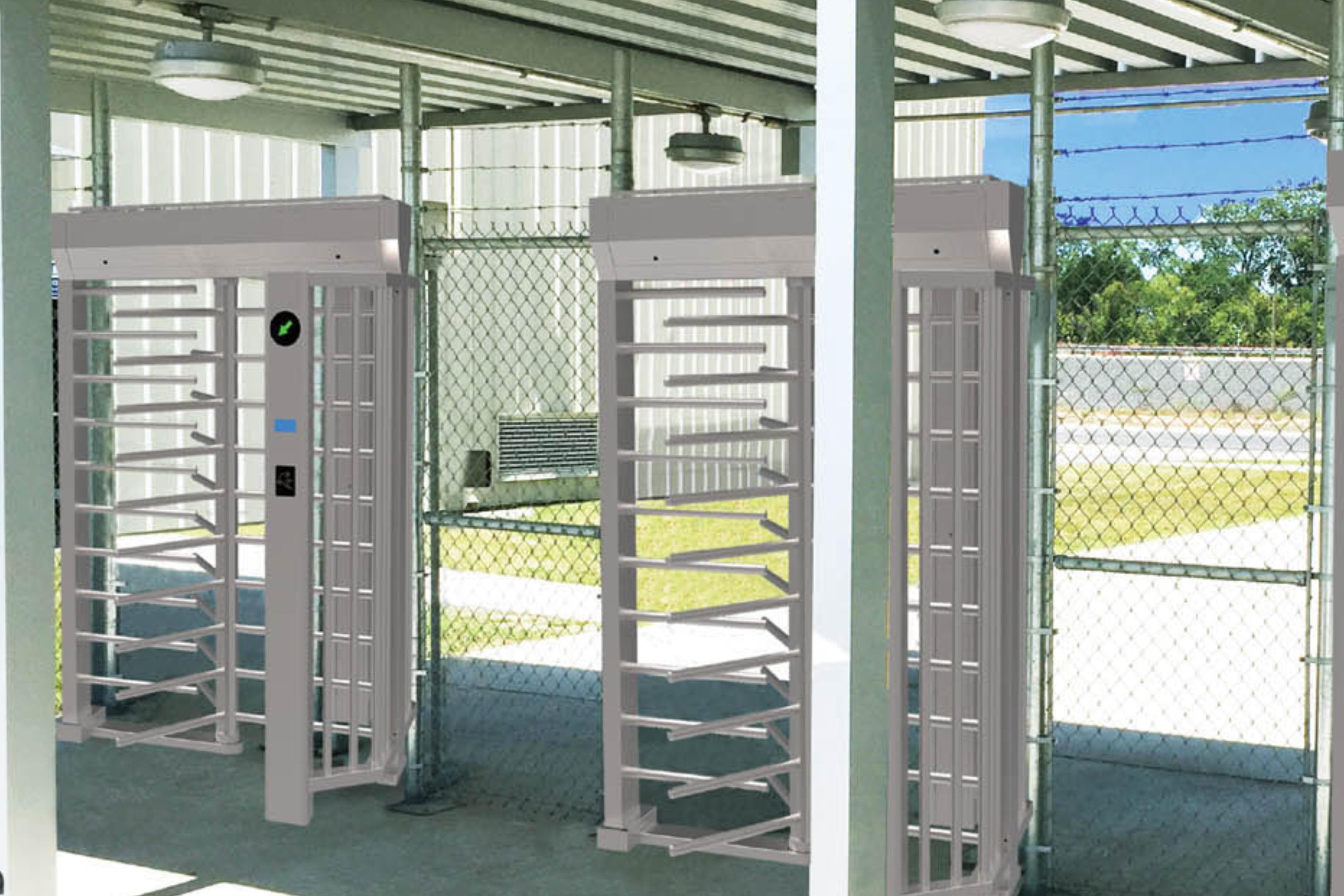
| Tripod turnstile | Flap barrier | Swing barrier | Full-height turnstile | |
|---|---|---|---|---|
| Mechanism | Three arms on an angled rotor; the user pushes through a 120-degree segment after release | Flaps retract horizontally into the pedestals | Solid panels rotate open through an arc on a vertical pivot | Full-height rotor with vertical bars turning within a fixed cage |
| Anti-tailgating method | Mechanical. One release permits exactly one rotation; a second person cannot follow | Sensor-based. An infrared array counts bodies and alarms on a violation | Sensor-based, same principle as the flap barrier | Mechanical and complete; the cage blocks the opening from floor to head height |
| Accessibility | None. A separate controlled wide gate is required | Standard lanes are narrow; a wide accessible lane is normally added alongside | Wide-panel versions often serve as the accessible lane in a bank of gates | None. A separate controlled accessible gate is always required |
| Throughput | Moderate; commonly quoted around 20 to 30 people per minute per lane, equipment-dependent | Faster; commonly quoted around 30 to 40 people per minute per lane, equipment-dependent | Moderate; the panel sweeps an arc, so the cycle is longer than a flap | Lowest of the four; the rotor is large and each passage takes longer |
| Behaviour in dust and heat | Tolerant. The damper and rotor assembly are the parts to protect and service | Sensitive. Optical arrays foul and produce nuisance alarms; light flaps can be forced | Sensitive for the same reason, with a heavier panel and a loaded drive | Tolerant, with a larger mechanism and more exposed surface to maintain |
| Typically suited to | Plant and contractor gates, construction compounds, stadium entry lines, campus gates | Office cores, finished concourses and high-traffic indoor entrances | Reception areas needing a wider lane and mixed pedestrian and trolley traffic | Perimeter lines, unmanned entrances, substations and high-security compounds |
The four are not better and worse versions of one another. A tripod is chosen for mechanical enforcement and durability, a flap barrier for throughput and appearance, a swing barrier for lane width and mixed traffic, a full-height turnstile for an unmanned perimeter that must not be climbed. Many Saudi sites use more than one type on the same entrance, a bank of tripods for the shift crowd, a controlled wide gate beside them, and a full-height unit on the perimeter after hours.
Frequently Asked Questions
How does a tripod turnstile allow only one person at a time?
The rotor carries a cam plate with three notches, one per arm position, and a spring-loaded pin sits in whichever notch is presented. A valid credential energises a solenoid that pulls the pin clear, and the rotor turns 120 degrees until the next notch arrives beneath the pin and locks it again. One release permits exactly one rotation, so a second person finds the rotor locked and must present their own credential.
Why does a tripod turnstile rotate 120 degrees?
Three arms set 120 degrees apart is the smallest arrangement that keeps one arm blocking the lane while another is clear of the walking path. Two arms would need a 180-degree turn, sweeping the trailing arm through the user's path, and four arms would leave a gap too narrow for comfortable passage. The rotor head is also mounted at an angle, so the arms sweep upward and away as the person walks through.
What is the damper in a tripod turnstile, and why does it wear faster on Saudi sites?
The damper is a hydraulic or friction unit on the rotor shaft that governs rotation speed, stopping the arms being spun violently and bringing them to a controlled stop as the lock re-engages. It wears faster here because fine airborne particulate reaches its seals and working surfaces, and because sustained high temperature changes a hydraulic unit's characteristic. A lane that feels loose, notchy or slams at the end of rotation is usually reporting the damper, not the lock.
What is the difference between a mechanical, semi-automatic and fully automatic tripod turnstile?
A mechanical tripod has no electrical release and turns freely in the permitted direction, or is released by a coin, token or attendant lever. A semi-automatic tripod uses a solenoid or electromagnet to release the lock on a valid credential, and the user pushes the arm. A fully automatic tripod releases the lock in the same way, but a motor drives the rotation through the full 120 degrees.
What is a drop-arm tripod turnstile?
A drop-arm tripod holds its three arms on a latch rather than fixing them rigidly to the hub. On a fire alarm signal or a loss of power the latch releases and all three arms fall vertically, leaving the lane physically clear so people can evacuate in a crowd without turning the rotor. The arms are re-set by hand afterwards, and the latch should be tested on a defined cycle because it is a dust-sensitive mechanism.
What happens to a tripod turnstile during a fire alarm or power failure?
It depends on which egress strategy was designed in. A drop-arm unit releases its arms so the lane clears completely. Other installations keep a fail-locked rotor and route evacuation through a separate adjacent emergency gate released by the fire panel. Some units are fail-safe and some fail-secure, varying by model. In Saudi Arabia arrangements of this kind on occupied premises fall within the framework of the General Directorate of Civil Defense, so the decision belongs with the fire strategy at design stage.
Are tripod turnstiles wheelchair accessible, and what is needed at a facility serving elderly visitors or pilgrims?
No wheelchair, trolley, stretcher, pram or large item of luggage can pass through a tripod turnstile, and no configuration changes that. At a facility serving elderly visitors or pilgrims, an entrance built only from tripods is unworkable, and an adjacent controlled wide gate is mandatory rather than optional. That gate must carry its own reader, lock and log entry, because one left on a manual latch or propped open at the peak becomes the weakest point in the whole line.
Does airborne dust affect a tripod turnstile, and what does it damage first?
Yes, and it is the dominant wear mechanism on a Saudi gate. Fine particulate reaches the damper's seals and working surfaces, the cam plate notches and locking pin that engage on every passage, and the rotor bearing if its seal is compromised. The damper usually reports the problem first, as a rotation that feels loose or notchy or a lock that slams rather than seats. Enclosure sealing is the design answer and condition-based service intervals are the maintenance answer.
Does summer heat change how many people a tripod turnstile lane can pass?
It can. Duty figures are quoted at a reference ambient, and at 45 to 50°C (hotter still inside a steel housing in direct sun) the solenoid, control board and power supply all have less thermal headroom, so the permissible sustained rate falls. A hydraulic damper's fluid also thins as it heats, which changes the feel of the rotation. Lane counts for a compressed shift change should be sized from observed peak arrival rather than a catalogue rate.
Can a tripod turnstile be used in both directions?
Yes. Most models carry separate release logic for each direction, so a lane can be set to control entry while leaving exit free, to control both directions, or to allow one direction only. If anti-passback, live occupancy counting or muster reporting is required, both directions must be controlled, because none of those works unless exits are actually read, and controlling both directions roughly doubles the passages each lane handles.
Which standards and authorities apply to turnstiles in Saudi Arabia, and who supports the equipment locally?
Life-safety behaviour on occupied premises falls within the framework of the General Directorate of Civil Defense, and equipment specifications commonly reference standards published by SASO, the Saudi Standards, Metrology and Quality Organization, and by GSO, the GCC Standardization Organization. Large industrial and government clients frequently add their own technical specifications. Because requirements change and vary by facility type, the current position must be confirmed with the relevant authority for the specific project. Within the Kingdom, TimeWatch equipment is represented through Shuruq Saudi as authorised national distributor.
