
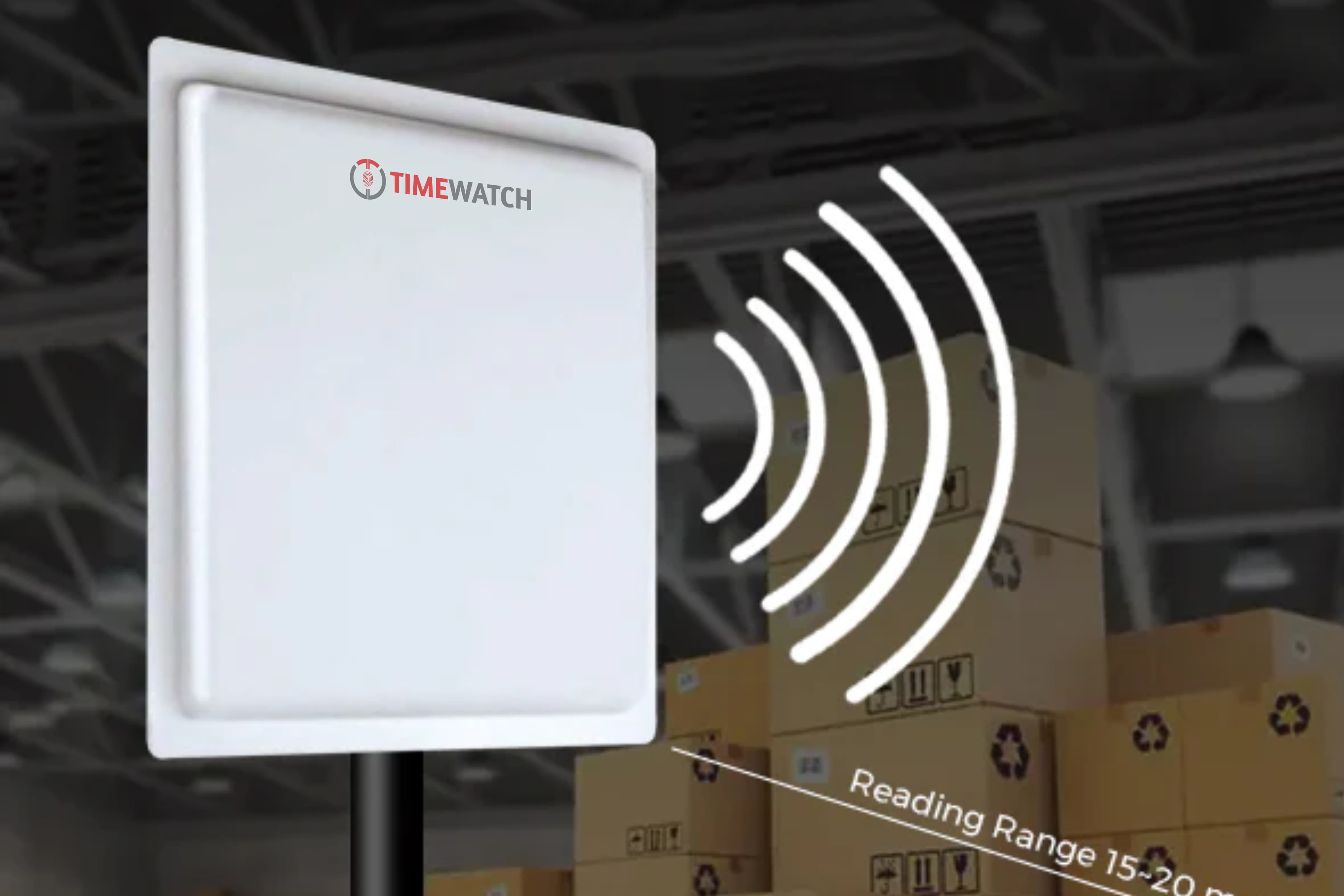
How Does a UHF RFID Reader System Work?
What Is a UHF RFID Reader System?
The commercial point of the technology is that nothing has to stop, align or be presented. A tanker rolls up to a plant gate and is already identified. A tool crib is inventoried by walking a handheld reader down the aisle. A contractor pickup is recognised at the compound entrance without the driver lowering a window into a July afternoon. Everything difficult about deploying UHF RFID follows from that same property: energy that travels several metres does not stop where you drew the line.
How Does a UHF RFID Reader System Work?
A UHF RFID reader system works in four stages. The reader transmits RF energy through coaxial cable to one or more antennas, which radiate it into a defined area. A passive tag entering that area harvests enough energy to wake its chip. The chip replies by backscatter, modulating how much energy it reflects so the reflection carries its identifier. The reader decodes the returned signal and passes the identifier to a controller or host application.
Transmit, harvest, backscatter, decode. Everything below sits beneath those four words, including the engineering that decides whether the system still behaves the same way when the antenna has been in full sun since dawn and the windscreen tag has been baking behind laminated glass for two summers.
The Working Principle: Energy Harvesting and Backscatter
How a passive tag powers itself
A passive tag is an antenna printed or etched on a substrate with a small chip bonded to it, no battery, no oscillator, no stored energy at all. In the reader's field an alternating voltage appears across the antenna terminals. A rectifier, in practice a multi-stage charge pump, converts it to a small DC supply that accumulates on a capacitor until the chip's logic comes out of reset. Electrically the tag exists only while it sits in a field strong enough to power it. Read range is therefore a property of the installation, not of the tag alone, and a figure printed on a tag datasheet describes a laboratory, not a gate.
What backscatter actually means
Generating a carrier of its own would need far more energy than the tag has harvested, so it cannot transmit in the ordinary sense. Instead it switches its own antenna between two impedance states: in one it reflects more of the incoming energy, in the other less. Switching in a timed pattern imposes its data onto the energy it is already bouncing back. The reader transmits and listens at the same time, sees its own carrier returning with a faint pattern superimposed on it, and decodes the bits. The returning signal is extremely weak relative to the transmitted one, which is why every decibel lost between reader and antenna is paid for twice.
Why UHF reaches metres when HF reaches centimetres
LF and HF systems work by inductive coupling: the reader coil produces a magnetic field and the tag coil sits inside it like a transformer secondary. That coupling falls away very sharply with distance, which is why 125 kHz and 13.56 MHz readers work at centimetres and need the card presented deliberately. UHF works by radiative coupling. The wavelength in the UHF RFID region is roughly a third of a metre, short enough for a compact antenna to radiate efficiently, and the tag is illuminated by a propagating wave rather than held inside a magnetic field. The same property that gives the range gives the problems: radiated energy reflects off metal, is absorbed by water, and travels past the point where you wanted it to stop.
Frequency Allocation: Confirm the Band Before Equipment Is Chosen
This point sits here, early, because it governs procurement rather than configuration, and getting it wrong is not something a site engineer can correct later.
UHF RFID does not use one worldwide frequency. National administrations allocate different sub-bands and different radiated power limits for RFID use, and a reader is manufactured and type-approved for a specific band. A unit built for one region's allocation is not simply re-tuned on site; its radio front end, filtering and approval documentation all belong to that band. Tags are more tolerant (a modern EPC Gen2 inlay is usually designed to respond across a wide span) but their performance is not flat across it, so a tag optimised for one regional band will not necessarily give the same read distance on another.
For a project in the Kingdom, the practical rule is simple and should be written into the specification:
- Confirm the UHF RFID band and the permitted radiated power allocated for this market with the national telecommunications regulator, and obtain that confirmation in writing before readers, antennas and tags are selected.
- Confirm the type approval and equipment registration arrangements that apply to the radio equipment being imported and installed, and establish who in the supply chain carries that obligation.
- Specify the reader variant by band in the purchase documentation, not by model family alone. Most manufacturers publish regional variants of the same reader, and ordering the wrong variant is an easy and expensive mistake to make on paper.
- Have the supplier state the tag's performance in the band that applies here, rather than accepting a generic range figure measured somewhere else.
Nothing on this page should be read as a statement of the current allocation, and no figure quoted elsewhere for another country should be assumed to apply. Spectrum allocations are set nationally and change over time; the regulator is the only reliable source.
LF, HF and UHF RFID Compared
| Aspect | LF, 125 kHz | HF, 13.56 MHz | UHF |
|---|---|---|---|
| Coupling method | Inductive, near field | Inductive, near field | Radiative, far field |
| Typical read range | A few centimetres | Around 10 cm in access use | Metres, depending on antenna, tag and placement |
| Metal and liquid tolerance | Good | Moderate; some detuning near metal | Poor without design allowance, metal reflects, water absorbs |
| Multi-tag reading | Generally one at a time | Possible but limited | Designed for it; anti-collision resolves large populations |
| Frequency allocation | Broadly consistent internationally | Broadly consistent internationally | National sub-band and power limit, confirm with the regulator |
| Typical use | Animal tagging, proximity cards, immobilisers | Access and smart cards, payment, NFC | Vehicle access, parking, asset and equipment tracking, inventory |
Frequency choice is not a question of one band outperforming another. It is a question of whether the application needs a deliberate presentation gesture at close range, or identification of something moving past at a distance.
Main Components of a UHF RFID Reader System
| Component | Function |
|---|---|
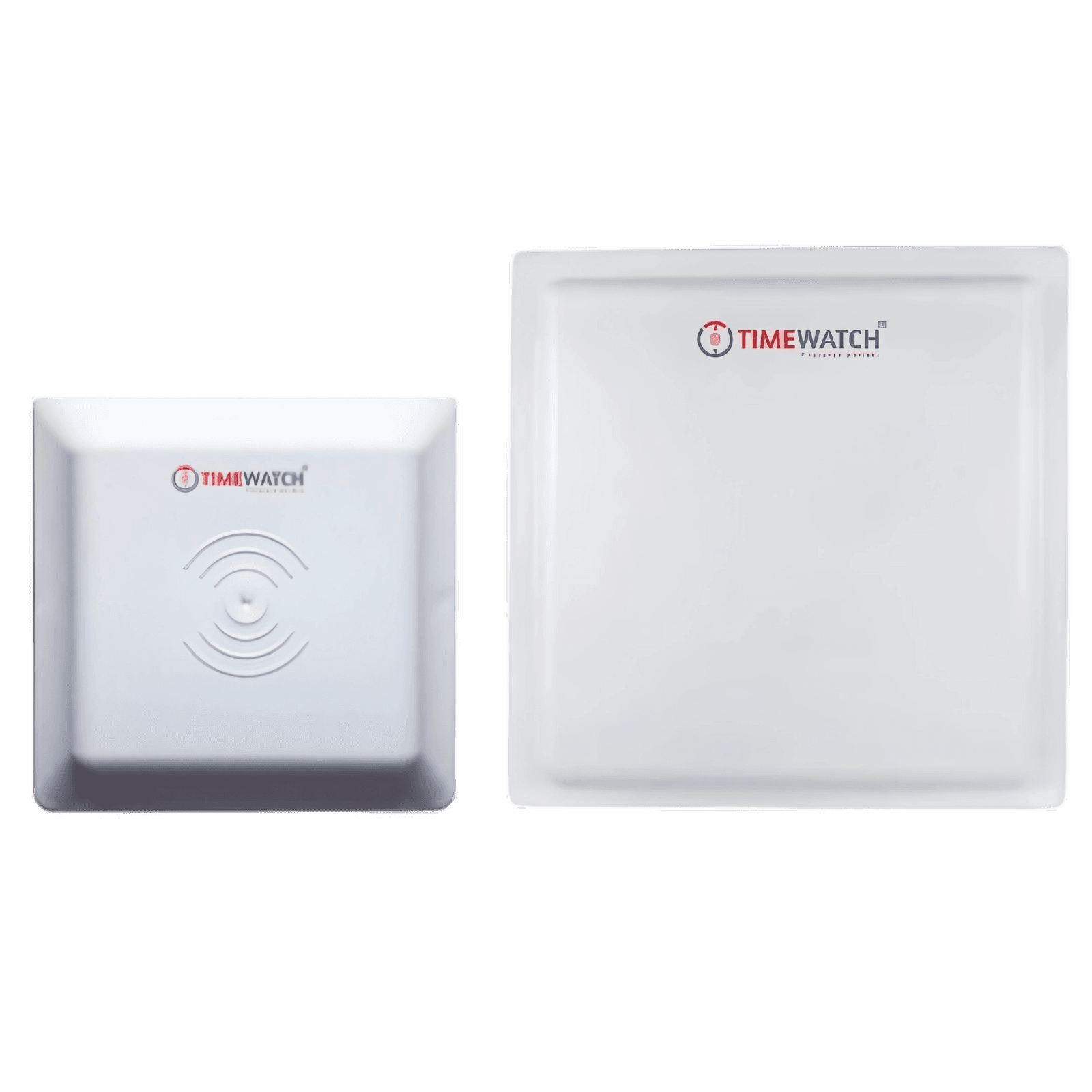
| Reader (fixed) | Generates the RF carrier, drives several antenna ports, decodes backscatter and outputs tag data over the network. On an outdoor Saudi gate its enclosure rating and its mounting position matter as much as its radio performance. |
| Reader (integrated) | Reader and antenna in one housing, simpler to mount and cable, less flexible in aiming and port count, and with the electronics unavoidably out on the pole in the sun. |
| Antennas | Radiate the field and capture the returning backscatter. Gain and polarisation define the read zone; the radome keeps dust and water out of it. |
| Coaxial cable and connectors | Carry RF between reader and antenna. Every metre loses signal in both directions, and every outdoor connector is a water and dust ingress point. |
| Passive tags | Windscreen sticker, hard tag, on-metal tag or label, chosen by mounting surface and by the environment the surface sits in, not by preference. |
| Middleware / controller | Filters, de-duplicates and time-stamps raw reads, turning a continuous read stream into discrete events. |
| Host software | Access control, parking, asset or plant management platform holding the tag-to-identity mapping and the permission rules. |
| Output interface | Relay, Wiegand, RS-485 or network message to a barrier controller, door controller or server. |
| Enclosure and surge protection | Outdoor housing, gasketing, earthing and surge arrestors on long cable runs. On exposed desert and coastal gates this is a functional component, not a detail. |
How Does a UHF RFID Reader System Work Step by Step?
| Step | What happens | How it works |
|---|---|---|
| 1 | Reader energises the antenna | An RF carrier in the nationally allocated UHF RFID band is delivered through coaxial cable to the antenna port. |
| 2 | Antenna radiates a field | Gain and polarisation shape that energy into a read zone covering the lane, doorway or shelf. |
| 3 | Tag enters the field | A windscreen tag, hard tag or label on the vehicle or item crosses into the illuminated volume. |
| 4 | Tag harvests energy | Induced voltage is rectified to DC by a charge pump and accumulates until the chip powers up. |
| 5 | Reader runs an inventory round | The reader issues a query specifying a number of reply slots; each powered tag picks one at random. |
| 6 | Tag replies by backscatter | In its slot the tag switches antenna impedance in a timed pattern, modulating the reflected energy. |
| 7 | Reader decodes the identifier | The receiver extracts the modulation from its own returning carrier and resolves the identifier. |
| 8 | Tag is singulated and silenced | The reader acknowledges the tag, which stays quiet so the remaining tags can be resolved. |
| 9 | Middleware filters the stream | Repeat reads collapse into one event; weak or out-of-zone reads are discarded on signal strength. |
| 10 | Host application acts | The identifier is matched to a record and an output raises the barrier, releases the door or updates the asset register. |
Shaping the Read Zone
A read zone is not a sphere around the antenna. It is a shaped volume, and shaping it deliberately is most of the engineering work in a UHF installation. The recurring complaint on vehicle installations is never that tags do not read, it is that the wrong ones do.
Antenna gain and mounting angle
Gain does not create energy, it concentrates it. A higher-gain antenna produces a narrower, longer beam from the same power; a lower-gain one produces a wider, shorter beam. Mounting angle decides where that beam lands. Aimed straight down a lane it reads vehicles far away, including the ones queued behind and the ones in the adjacent lane. Angled downward onto the road a few metres ahead of the barrier, the same antenna reads the vehicle at the stop line and very little else.
Circular and linear polarisation
A linearly polarised antenna concentrates energy in one plane: range is longer when the tag's orientation matches that plane and collapses when it does not. A circularly polarised antenna sweeps the plane continuously, coupling to a tag at any rotation but at roughly half the effective range. The choice follows from whether orientation is predictable. A windscreen tag sits in a known, fixed position on every vehicle, so linear polarisation is reasonable at a gate. A hand-carried asset tag, a tagged valve on a pallet, or a toolbox loaded onto a pickup arrives at any angle, and circular is the pragmatic answer.
Transmit power and coaxial cable loss
Transmit power is set within the limits permitted for the band by the national allocation, but the power reaching the antenna is always less than what leaves the reader, because coaxial cable has loss, and that loss is paid twice, once on the outgoing carrier and again on the very weak returning backscatter. A long run between a reader mounted conveniently inside an air-conditioned gatehouse and an antenna out at a wide plant gate can lose enough signal to measurably shorten read range. Reader placement is a design decision rather than a convenience. Where the electronics genuinely cannot sit close to the antenna, the alternatives are lower-loss cable or an integrated reader at the read point, and on a Saudi gate that second option carries its own consequence, because it puts the electronics in the sun.
Why Tags Fail to Read: Metal, Water and Orientation

Metal detunes and reflects. A tag antenna is designed for a particular electrical environment. Place a standard label directly on metal and the metal changes its impedance, destroying the match and reflecting the field away, so the tag reads poorly or not at all. On-metal tags exist as a distinct product class for this reason: they carry a spacer or ground plane so the antenna works against a conductive backing. On an industrial site, where most of the things worth tagging are made of steel, this is not an edge case, it is the default condition.
Water absorbs. At UHF, water absorbs RF strongly. Tags on drums of liquid, on damp materials or close to a human body read at much shorter distances than the same tags in free air, so load geometry matters as much as the tag specification.
Orientation decides coupling. A tag presented edge-on to a linearly polarised field couples badly however good it is. Tag selection is an engineering choice driven by mounting surface and read geometry, and a trial on the actual material, in the actual position, on the actual vehicle class is worth more than any datasheet range figure.
Duplicate Reads and the Job of the Middleware
A tag inside a read zone is not read once. It is read many times per second for as long as it stays there, so one truck waiting at a plant gate can generate hundreds of reads of the same identifier. Deciding which of those constitute a single event is the job of the middleware, not the reader. Typical rules include a debounce window suppressing repeat reads of the same tag, a received-signal-strength threshold ignoring weak reads from outside the intended zone, a minimum read count before an event is declared, and antenna-port logic inferring direction from which antenna saw the tag first. Without that layer a gate log records one vehicle arriving several hundred times, and the access record becomes unusable for the permit and shift reporting it was installed to produce.
How Saudi Conditions Affect a UHF RFID Installation
The physics above does not change in the Kingdom. What changes is how long the hardware and the tags survive while performing it, and that belongs in the specification rather than in the first service report.
Heat, direct sun and windscreen tag survival
This is the single most under-specified item on Saudi RFID projects, and it is not about the radio at all. A windscreen tag is a thin inlay with an adhesive layer, applied to the inside of glass that sits in direct sun for most of the year. Summer shade temperatures across much of the Kingdom sit above 45 °C and inland sites regularly approach 50 °C; the glass itself, and the air trapped against it inside a parked vehicle, run considerably hotter than that.
Three things follow. First, adhesive performance is a specification item. A general-purpose pressure-sensitive adhesive can soften, creep, bubble or let go at sustained high surface temperature, and a tag that has lifted at one corner no longer sits flat against the glass, which changes its electrical behaviour before it falls off entirely. Ask the supplier for the adhesive's service temperature range and its substrate recommendation for glass, rather than accepting a tag described only as a windscreen tag. Second, surface preparation decides whether the stated adhesive performance is ever achieved: dusty, filmed or still-warm glass gives a bond that will not survive the first summer, so tags should be applied to clean, cool glass in shade, not at a gate in the middle of the afternoon. Third, sustained heat ages the inlay as well as the glue, so tag populations in this climate should be expected to need replacement sooner than a temperate-climate assumption suggests, and the enrolment process should make reissue straightforward rather than exceptional.
The same heat argument applies to the reader. Electrolytic capacitors in power supplies and control boards age faster at elevated temperature, and an integrated reader bolted to a south-facing pole with no shade is operating at a different internal temperature from the one on the datasheet. Where the layout allows, mount readers and antennas under the gatehouse canopy or behind a simple sun shield, choose light-coloured enclosures over dark ones, and keep the electronics out of the direct afternoon beam. These are decisions taken before the pole is set, and they are almost always taken by accident instead.
Sand and dust on antennas, radomes and enclosures
Airborne sand and dust is the dominant wear mechanism on outdoor equipment across the Kingdom, and it reaches a UHF installation in four ways. It accumulates on antenna radomes, where a dry dust layer is largely transparent to RF but becomes a problem once it is damp and holds moisture against the face. It works into unsealed cable glands and connector bodies, where fine particles and later moisture degrade the RF connection and quietly reduce range. It settles inside reader and controller enclosures, insulating components that need to shed heat. And it abrades gaskets and seals on any enclosure opened frequently for maintenance, so each service visit slightly reduces the protection the housing was specified to provide.
The practical responses are a dust-tight enclosure rating with gasketed doors and sealed cable entries, connectors made up correctly and weatherproofed rather than taped, a scheduled radome and lens wipe treated as a routine item rather than a reaction to a complaint, and a standing instruction to inspect after any significant dust event regardless of where the site sits in its schedule.
Coastal salt at Red Sea and Gulf sites
Inland and coastal sites are different corrosion environments and specifying them identically is a mistake in both directions. Inland, at Riyadh or Tabuk, the air is dry and the dominant problems are heat and abrasion. Along the Red Sea coast at Jeddah and Yanbu, and along the Arabian Gulf at Jubail, Dammam and Al Khobar, humidity is high for much of the year and the air carries salt aerosol. Salt is hygroscopic: it draws moisture from humid air and holds a conductive film against metal long after any visible wetting has gone.
For an RFID read point the most vulnerable items are the coaxial connectors and the antenna mounting hardware. A corroded connector interface raises loss, and because that loss is paid twice the symptom is a steady, unexplained decline in read rate over months rather than a clean failure. Specify weatherproofed connectors with the correct sealing arrangement, stainless mounting hardware of an appropriate grade, galvanised or marine-grade poles and brackets, and attention to dissimilar-metal contact at joints. Conformal coating on control boards is a reasonable thing to ask about during technical evaluation on a coastal installation.
Setting intervals from conditions, not from a calendar
A fixed number of visits per year fits this environment badly, because the variables that drive degradation (exposure, dust load, proximity to salt air, and how many tags pass per day) vary enormously between sites in the same province.
| Site condition | Dominant stress | Attention pattern typically suited to it |
|---|---|---|
| Inland plant or logistics gate, open desert exposure | Solar heat on hardware, abrasive dust on radomes and seals | Short intervals. Radome cleaning, connector inspection and read-rate review well ahead of a standard schedule; treat dust as a scheduled item in its own right. |
| Inland compound gate within a built environment | Moderate dust, high solar load on tags and readers | Standard servicing, with tag condition sampling added, check a sample of windscreen tags for lifting or discolouration at each visit. |
| Coastal site, any throughput | Salt-laden humidity plus dust | Connector and mounting-hardware corrosion inspection at every visit, with early attention to any coating damage before it spreads. |
| Indoor warehouse or workshop portal | Dust ingress, forklift impact on antenna mounts | Mounting and aim verification, since an antenna knocked out of alignment changes the read zone silently. |
| Site adjacent to active construction or earthworks | Very high particulate load | Temporary short-interval cleaning for the duration of the works. Common on new developments where the gate goes live before the surroundings are complete. |
Technologies Used in a UHF RFID System
- Radiative RF coupling: propagating waves in the UHF RFID band allocated by the national regulator for this market.
- Passive energy harvesting: rectifier and charge pump circuits producing DC from the received field.
- Backscatter modulation: impedance switching at the tag antenna to impose data on the reflected carrier.
- EPC Gen2 air interface: the command set, encoding and memory structure standardised as ISO 18000-63.
- Slotted ALOHA anti-collision: the Q algorithm resolving many tags through randomised reply slots.
- Antenna design: gain, beamwidth and polarisation determining read zone geometry.
- Signal-strength filtering: RSSI thresholds in middleware used to reject reads from outside the intended volume.
- Enclosure and environmental engineering: ingress protection, sealing, solar shading, earthing and surge protection suited to the site's exposure.
- Network and controller interfaces: TCP/IP, RS-485, Wiegand or relay outputs into host systems.
Where UHF RFID Reader Systems Are Used in Saudi Arabia
- Fleet and tanker access at industrial and petrochemical facilities: plant perimeters and process-area gates in the industrial cities of Jubail and Yanbu, where a windscreen or hard tag identifies the vehicle on approach, the access event is recorded against a permit-to-work regime, and shift changes and tanker movements produce sharply peaked traffic. Because fleet vehicles return many times a day, the enrolment burden is low and the throughput gain is large, which is precisely the profile UHF RFID suits.
- Contractor vehicle control at large compounds: a distinctive Saudi requirement. Major facilities run a contractor population that changes continuously, with vehicles authorised for a defined period, a defined gate and sometimes a defined area inside the site. A tag issued against a contract end date, revoked centrally the moment the contract closes, and verified at the gate against the vehicle's plate is considerably more controllable than a paper pass. The design question is the reissue and revocation process, not the radio.
- Asset and equipment tracking across sprawling sites: plant and industrial facilities here are large enough that locating a specific item is a genuine operational problem. Tagged tools, instruments, scaffolding components, valves, gas cylinders and returnable containers can be inventoried by walking or driving a handheld reader through an area, or counted automatically at a yard portal. On-metal tags are the norm rather than the exception in this application.
- Vehicle access at ministry, corporate and residential compounds: staff and resident vehicles identified on approach so the barrier is already opening, with visitors handled at the guard post through a visitor process or by plate recognition.
- Ports and logistics gates: truck identification at Jeddah Islamic Port on the Red Sea and King Abdulaziz Port at Dammam, where the read event sits inside a wider gate process alongside document verification, weighbridge and release.
- Universities, hospitals and medical cities: large campuses in Riyadh, Jeddah, Dhahran and Abha with concentrated arrival peaks, staff and visitor parking separation, and asset tracking requirements inside the buildings as well as at the gates.
- Retail and mixed-use developments: resident and staff lanes on tags, public lanes on ticket or plate, across the Riyadh, Makkah and Eastern Provinces.
- New developments and giga-projects: large master-planned schemes generate requirements in phases, first at construction and logistics gates with heavy vehicles and extreme particulate load, then at the permanent gates with full access control integration. Specifying for both phases at the outset avoids replacing the installation between them.
- Linen and laundry management: wash-resistant tags in hotel and hospital linen counted in bulk, where water absorption makes portal geometry a design matter rather than a detail.
TimeWatch supplies UHF RFID readers, antennas and tags alongside the barrier, parking and access control equipment used with them, and is represented in Saudi Arabia through Shuruq Saudi as authorised national distributor for the Kingdom.
Integration With Other Systems
- Boom barriers and gates: a valid read produces the open command, with the barrier's own safety devices governing closing.
- Access control platforms: vehicle tag and cardholder share one database, so revoking a contractor closes both the door and the gate in a single action.
- ANPR cameras: plate recognition confirming the tag is on the vehicle it was issued to, which is the usual control against tag transfer between vehicles, and handling untagged visitors.
- Permit-to-work and contractor management systems: the read event checked against an active permit before release, so an expired contractor authorisation stops the vehicle at the gate rather than inside the plant.
- Parking management software: occupancy counting, allocation and shift reporting driven by entry and exit events.
- CCTV: each read event bookmarks video, so any passage can be reviewed directly from its log entry.
- Asset registers and maintenance systems: inventory reads reconciled against the system of record automatically, which is where the asset-tracking application earns its place.
- Weighbridges: the tag identifies the vehicle so the weighment is recorded against the correct trip.
- Under-vehicle inspection and screening equipment: on higher-security gates the read releases the vehicle only once the inspection stage has returned a clear result.
Installation Considerations for Saudi Sites
- Define the read zone and the exclusion zone before choosing hardware. Decide where a tag must read and, equally important, where it must not, then select gain, polarisation, angle and power to produce that volume.
- Control over-reading. Reading the adjacent lane or a vehicle queued behind is the commonest failure on vehicle installations, and it is solved with polarisation, downward antenna angle, reduced power, signal-strength thresholds and physical shielding, not by changing tags.
- Keep the cable run short, or accept a measurable range penalty, and weatherproof every outdoor connector properly.
- Plan the solar exposure of readers and antennas at design stage. A canopy or sun shield takes no extra effort to draw and materially extends the life of the electronics.
- Match the tag to the surface and to the climate. Glass, painted metal, bare steel, plastic and fabric each need a different tag construction, and the adhesive specification matters as much as the inlay.
- Survey for reflective structures. Steel shutters, metal canopies, tanker bodies and parked vehicles create read points where none was intended, and this is more pronounced in the open, hard-surfaced yards typical of industrial sites here.
- Avoid reader-to-reader interference. Readers at adjacent lanes need separation, synchronisation or channel planning within the permitted band.
- Protect outdoor electronics with the correct enclosure rating, earthing and surge protection on long cable runs, dry, dusty conditions also build static.
- Confirm the radio band and type approval position before equipment is ordered, as set out earlier on this page.
- Commission with real traffic at the speeds, orientations and vehicle mix the site actually sees, and during the hot part of the day rather than at dawn.
Maintenance Considerations
- Inspect antenna mounting and aim. An antenna knocked by a vehicle or loosened by vibration changes the read zone silently and the symptom appears as intermittent access failures.
- Clean antenna radomes and reader windows on a schedule driven by the site's dust load, not by the calendar.
- Check coaxial connectors for dust ingress, water and corrosion, the usual cause of gradual outdoor range loss, and the first thing to inspect at coastal sites.
- Review read statistics periodically. A falling read rate almost always indicates a physical change rather than a software fault.
- Sample windscreen tags for lifting, bubbling or discolouration at each visit, and replace them before they fail. Windscreen tags are destroyed on removal, so a replaced windscreen also means a replaced tag.
- Inspect on-metal and hard tags on plant equipment for impact damage, paint overspray and cleaning-chemical attack.
- Re-verify middleware filtering rules after any change to lane layout, traffic flow, vehicle mix or antenna position.
- Carry out an additional inspection after any major dust event, focusing on radomes, enclosure seals and cable entries.
- Keep firmware current and record the full configuration (power setting, session and Q parameters, antenna port map, filter rules) so a replacement unit can be commissioned identically.
Regulatory and Standards Context in Saudi Arabia
A UHF RFID installation touches two distinct regulatory areas, and they are easy to conflate.
The first is radio spectrum. The reader is an intentional radiator, so the band it operates in, the radiated power it may use and the type approval and registration arrangements for the equipment are matters for the national telecommunications regulator. This is the question to settle first, because it constrains which equipment can be bought at all. Current requirements must be confirmed with the relevant authority for the specific project, in writing.
The second is the installation the reader sits inside. Where the RFID read point controls a barrier or a door on an occupied site, the life-safety behaviour of that barrier or door sits within the framework administered by the General Directorate of Civil Defense, and the emergency-open arrangements should be designed in from the start rather than retrofitted. On the equipment side, specifications in the Kingdom commonly reference standards published by SASO, the Saudi Standards, Metrology and Quality Organization, and by GSO, the GCC Standardization Organization, along with the conformity and product-registration arrangements SASO administers for goods placed on the Saudi market. Large clients (government bodies, industrial and port operators, major developers) also publish their own technical specifications, which frequently go beyond the general framework on ingress protection, coating systems and operating temperature range.
Two points should be stated plainly. Nothing on this page should be read as a statement that any particular product is approved, certified or compliant under any of these frameworks: this section is context, not a claim, and conformity status is a property of a specific model and a specific supply, evidenced by documentation for that supply. And current requirements must be confirmed with the relevant authority for the specific project, because they change over time and vary by project type and by the client's own specification.
Benefits and Limitations
Benefits
- Identification without stopping, aligning or presenting a credential, which keeps cabins closed and lanes moving through the hottest hours.
- Many tags resolved in a single pass, which makes bulk counting and area inventory practical.
- Passive tags need no battery and no servicing, so a large population carries no recurring power maintenance.
- No line of sight required, so a tag inside a crate or behind a windscreen still reads.
- Events feed directly into access control, permit, parking and asset systems with a timestamped record.
- Central revocation makes contractor and fleet turnover manageable at compound scale.
Limitations and considerations
- The tag identifies the tag, not the driver. A windscreen tag authorises the vehicle whoever is behind the wheel. Where the person matters, pair it with card, biometric or plate verification.
- Read zones leak. Radiated energy does not stop at a painted line, and containing it is design work at every site.
- Metal and liquid degrade performance unless tag class and mounting are chosen for them, which, on an industrial site, is most of the tag population.
- Range figures are conditional, assuming favourable orientation, free space and full permitted transmit power.
- Middleware is not optional. Without filtering, the raw read stream is unusable as an event source.
- Tag survivability in this climate is a real design input. Heat and sun act on adhesive and inlay, and a tag population should be expected to need periodic replacement.
- The frequency band is set nationally, so equipment must be the variant permitted in this market and the position must be confirmed with the regulator rather than assumed.
Exact behaviour (read range, antenna ports, supported protocols, output interfaces, operating temperature range and environmental rating) depends on the specific reader, antenna, tag and site configuration, and should be confirmed against the datasheet and validated on site at the conditions the installation will actually experience.
UHF RFID vs ANPR: What Is the Difference?
| UHF RFID | ANPR | |
|---|---|---|
| What it identifies | A tag issued by the site operator | The number plate already on the vehicle |
| Needs prior enrolment | Yes, a tag must be fitted and registered | No, any plate can be read |
| Main sensitivity | Tag orientation, metal, liquid, read zone control, tag survivability in heat | Plate condition, camera angle, lighting, heat shimmer off asphalt, dust on the camera window |
| Typical fit | Regular fleet, staff, resident and contract vehicles | Visitors and occasional traffic |
| Local note | Tag adhesive and inlay must suit sustained high glass temperature | Saudi plates carry dual script, so the engine must be configured for that plate format |
The two are complements rather than alternatives, and many Saudi gates run both on one lane, with the controller accepting authorisation from either source and the plate used to confirm the tag is on the vehicle it was issued to.
Frequently Asked Questions
How does a UHF RFID reader read a tag that has no battery?
The reader's antenna radiates RF energy into the read zone. The tag's antenna picks up part of it, and a rectifier circuit inside the tag converts it to a small DC supply that powers the chip. The chip then replies by changing how much energy its antenna reflects back. The tag never generates a signal of its own, so it needs no battery and no servicing.
What is backscatter in RFID?
Backscatter is the method a passive tag uses to reply. Instead of transmitting, the tag switches its antenna between two impedance states, reflecting more energy in one and less in the other. Switching in a timed pattern imposes the tag's data onto the energy already bouncing back to the reader, which decodes that pattern out of its own returning carrier.
Which UHF RFID frequency band applies in Saudi Arabia?
UHF RFID does not use a single worldwide frequency. National administrations allocate different sub-bands and different radiated power limits, and readers are type-approved for a specific band rather than being retuned on site. The band and power limit that apply in this market, and the type approval and registration arrangements for the equipment, must be confirmed with the national telecommunications regulator before readers, antennas and tags are selected. A figure published for another country should never be assumed to apply here.
How far can a UHF RFID reader read a tag?
Several metres is typical for vehicle access with a windscreen tag, but range is a property of the whole installation rather than of the tag. Transmit power within the permitted limit, antenna gain, polarisation, mounting angle, coaxial cable loss, tag class and the surface the tag is mounted on all affect it, so published figures should be validated on site with the actual vehicles and the actual geometry.
Do summer temperatures above 45 degrees Celsius affect UHF RFID tags and readers in Saudi Arabia?
Yes, though not in the way people expect. The radio physics is unaffected, but the hardware and the tags are not. A windscreen tag sits on glass that runs far hotter than the shade air temperature, and a general-purpose adhesive can soften, creep or lift at those sustained temperatures, which changes the tag's behaviour before it falls off. Ask the supplier for the adhesive service temperature range and apply tags to clean, cool glass in shade. Sustained heat also ages reader electronics, so shading readers and antennas from direct sun and choosing light-coloured enclosures are worthwhile decisions taken at design stage.
Does airborne sand and dust affect UHF RFID read performance?
Indirectly, and the effect builds slowly. Dry dust on an antenna radome has little effect on the radio, but once it holds moisture against the face it begins to matter. The more damaging paths are dust working into cable glands and connector bodies, where it degrades the RF connection and quietly reduces range, and dust settling inside enclosures where it traps heat on components. Because connector loss is paid twice, on the outgoing carrier and on the weak returning backscatter, the symptom is usually a gradual decline in read rate rather than a clean failure. Dust-tight enclosures, properly weatherproofed connectors and scheduled radome cleaning are the responses.
Why does an RFID tag not read properly when it is stuck on metal?
A standard tag antenna is designed for a particular electrical environment. Metal changes its impedance and reflects the field away, so the tag is detuned and may read poorly or not at all. On-metal tags exist as a separate product class for this reason: they include a spacer or ground plane so the antenna works correctly against a conductive surface. On industrial sites most tagged items are metal, so on-metal tags are the normal choice rather than a special case.
How does a reader read many tags at the same time?
EPC Gen2 readers use a slotted ALOHA anti-collision protocol, known through its Q algorithm. The reader announces a number of reply slots and each powered tag picks one at random. A slot with a single tag produces a clean reply, which the reader acknowledges before silencing that tag for the rest of the round. Collisions are retried and the slot count is adjusted between rounds until the whole population is resolved one tag at a time.
Why does the reader pick up vehicles in the next lane?
Because radiated energy does not stop at a lane marking. Over-reading into an adjacent lane, or reading a vehicle queued behind, is the most frequent problem in UHF vehicle installations. It is corrected by changing antenna polarisation, angling the antenna downward onto the stop line, reducing transmit power, applying a signal-strength threshold in the middleware and adding physical shielding. Changing the tag rarely helps. Open, hard-surfaced industrial yards make it worse, because steel shutters, canopies and tanker bodies reflect the field into places it was never aimed.
Does the length of the antenna cable matter?
Yes. Coaxial cable has loss, and that loss is paid twice: once on the carrier going out to the antenna and again on the very weak backscatter coming back. A long run between a reader mounted inside a gatehouse and an antenna out at a wide plant gate reduces read range measurably, so reader placement is a design decision rather than a convenience. Where the reader cannot sit close to the antenna, lower-loss cable or an integrated reader is the alternative, though an integrated unit puts the electronics out in the sun and should be shaded.
How should a UHF RFID system be maintained on a Saudi industrial site, and who supports it locally?
Set intervals from the site's exposure and throughput rather than from a generic calendar schedule. An inland plant or logistics gate in open desert needs radome cleaning, connector inspection and read-rate review well ahead of a standard schedule, with an extra inspection after any major dust event. Coastal locations such as Jeddah, Yanbu, Jubail and Dammam add connector and mounting-hardware corrosion inspection at every visit. Sample windscreen tags for lifting or discolouration and replace them before they fail. For support within the Kingdom, TimeWatch equipment is represented in Saudi Arabia through Shuruq Saudi as authorised national distributor.
